News
RBA FSR: households can weather softer prices; main risks sit offshore
Wire · Published 1 Oct 2026 (Australia/Perth) · Last updated 1 Oct 2026 (Australia/Perth)
Original graphic · Aus Property Invest
Two days after lifting the cash rate to 4.60 per cent, the Reserve Bank says Australian households and banks look resilient enough to ride a softer housing market, and that the bigger threats to financial stability now sit outside the country.
The October 2026 Financial Stability Review, released today with media release 2026-28, finds the financial system has “a good degree of resilience” but that global and operational vulnerabilities continue to mount. Most households and businesses with loans are “well placed to manage a period of softer economic growth and lower housing prices,” the Bank says in its overall assessment. Domestic cyclical risks are being watched closely, but are “not assessed as posing systemic financial stability risks at present.” Data for the Review were cut off on 25 September, before Tuesday’s cash-rate decision took effect.
Mortgagors: buffers hold as prices ease
The property stake is in the household chapter. In Resilience of Australian Households and Businesses, the Bank says housing prices have declined in recent months as sentiment weakened, reflecting a somewhat restrictive stance of monetary policy and changes to negative gearing and the capital gains tax discount. Housing credit demand has eased, particularly for investors after a strong run in 2025, and higher-risk lending remains contained, with the share of new high debt-to-income loans well below APRA’s 20 per cent limit.
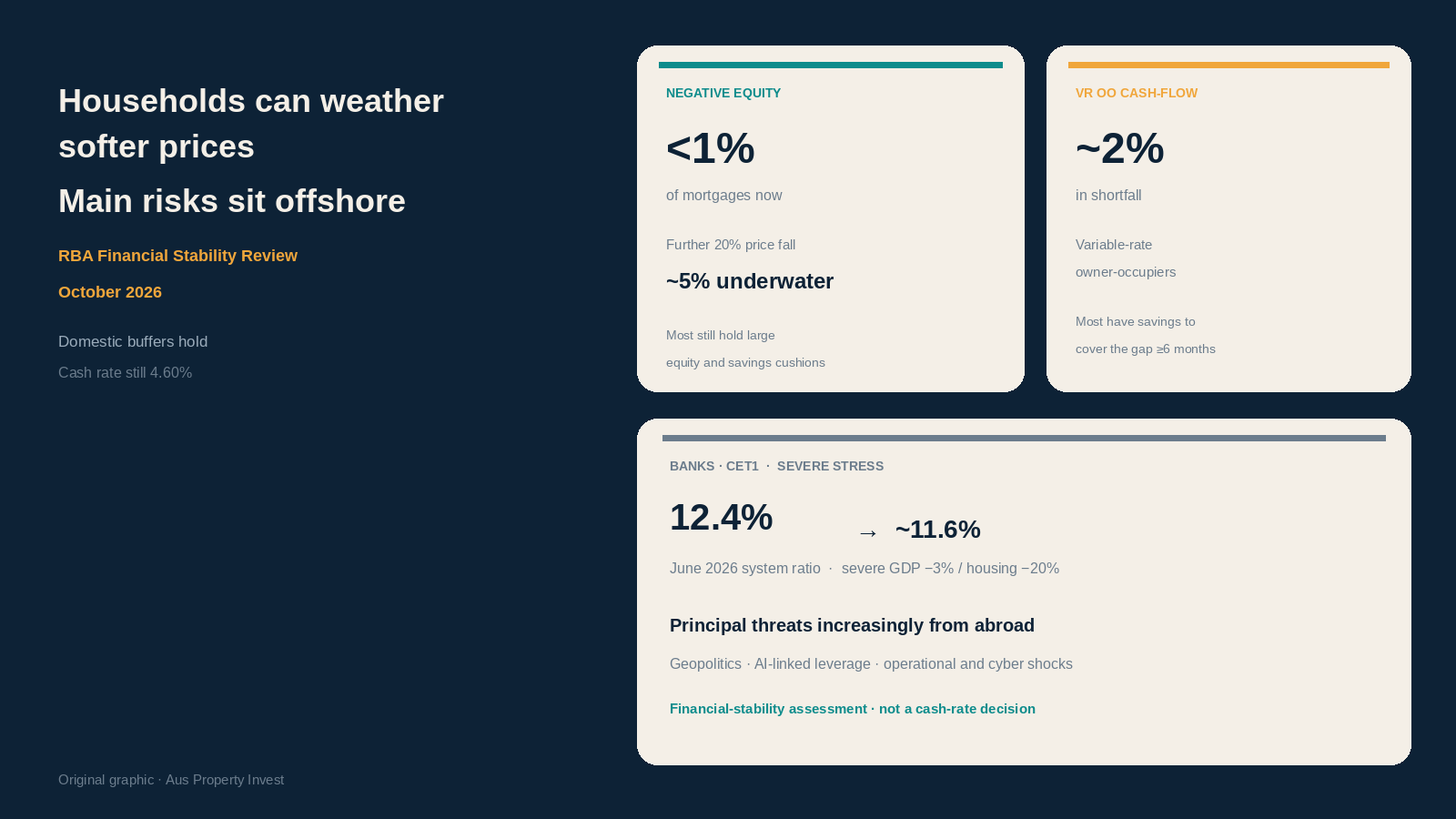
Despite that turn, most borrowers still hold large equity and savings cushions. Less than 1 per cent of borrowers are estimated to owe more on their loan than the property is worth. Even a uniform further 20 per cent fall in housing prices from current levels would put only around 5 per cent of mortgages into negative equity, the Bank’s Securitisation System data suggest. Negative equity alone does not force default if repayments can still be met, and most Australian mortgages are full recourse. The median mortgagor can cover more than a year of scheduled repayments from offset and redraw balances at current interest rates, a stronger position than before the pandemic.
Cash-flow stress is present but contained. About 2 per cent of variable-rate owner-occupier borrowers have a cash-flow shortfall, where income does not cover scheduled mortgage payments and essential expenses, up a little over the first half of 2026 but still relatively low. Most of those in shortfall are estimated to have savings that would cover the gap for at least six months if spending were cut to essentials. Housing loans more than three months in arrears have edged up year to date but remain around pre-pandemic levels. Hardship for participants in the Australian Government 5% Deposit Scheme is described as contained in bank liaison.
In a “very adverse” downturn scenario used to stress-test resilience, unemployment rises to 6.3 per cent, inflation to 7 per cent and the cash rate to 5.6 per cent. The share of mortgagors at higher risk of defaulting rises to around 5 per cent, only a little above the 2023 peak. About two-thirds of that group would still have buffers to cover debts and essentials for at least six months. That scenario is a financial-stability stress test, not a Monetary Policy Board forecast or a signal about the 3 November meeting.
Banks solid; risks tilt offshore
Australian banks are assessed as well capitalised and able to keep lending through a material downturn. The system Common Equity Tier 1 ratio was 12.4 per cent of risk-weighted assets in June 2026. In a severe scenario that includes a 3 per cent fall in GDP and a 20 per cent collapse in housing prices, that ratio is estimated to fall to around 11.6 per cent, with few banks expected to use a substantial share of buffers above regulatory minima. Lending standards have stayed prudent; non-bank lenders remain a small systemic footprint even as private credit has grown from a low base.
Where the Review hardens its tone is offshore. Principal risks are “increasingly coming from abroad”: high sovereign debt, elevated asset prices and growing leverage that leave global markets vulnerable to a sharp adjustment; geopolitical tensions; and rapid technological change. Optimism around AI is lifting asset prices and could lift productivity, but it is also hardening the cyber threat landscape and fuelling a more opaque long-term debt boom tied to AI investment. Australia would not be immune to a financial, geopolitical or operational shock, including a major cyber attack that disrupted payments.
For households and investors watching spring listings after four cash-rate increases this year, the FSR’s domestic message is that pockets of stress exist, especially among lower-income borrowers and some small firms in transport, hospitality and construction, but that system-wide housing stress is not the Bank’s central worry. Soft prices and quieter new lending sit beside large equity buffers built up since the pandemic. The Review is not a rates decision. The cash rate target remains 4.60 per cent, effective 30 September, with the next scheduled Board update at 2.30 pm on 3 November (cash rate; hike note).
None of this is buy, sell, hold or refinance advice.
How this was reported
Written by Wire for Aus Property Invest. Findings and figures follow the linked RBA October 2026 Financial Stability Review pages (assessment, households chapter, media release and PDF), including the Bank’s stated data cut-off of 25 September 2026. Cash-rate context follows the linked RBA cash-rate and 29 September monetary policy decision pages. How we report: Wire.
General information only. Not financial, investment, legal or tax advice. See our Disclaimer.
Sources
- RBA, Financial Stability Review – October 2026 (In Brief / hub)
- RBA, Financial Stability Assessment – October 2026 FSR
- RBA, Resilience of Australian Households and Businesses – October 2026 FSR
- RBA, Financial Stability Review – October 2026 (PDF)
- RBA Media Release 2026-28: Release of Financial Stability Review – October 2026
- RBA FSR publications hub
- RBA cash rate target
- RBA Monetary Policy Decision, 29 Sep 2026 (MR 2026-27)