News
RBA lifts cash rate to 4.60%, citing materialising inflation risks
Wire · Published 29 Sep 2026 (Australia/Perth) · Last updated 1 Oct 2026 (Australia/Perth)
Original graphic · Aus Property Invest
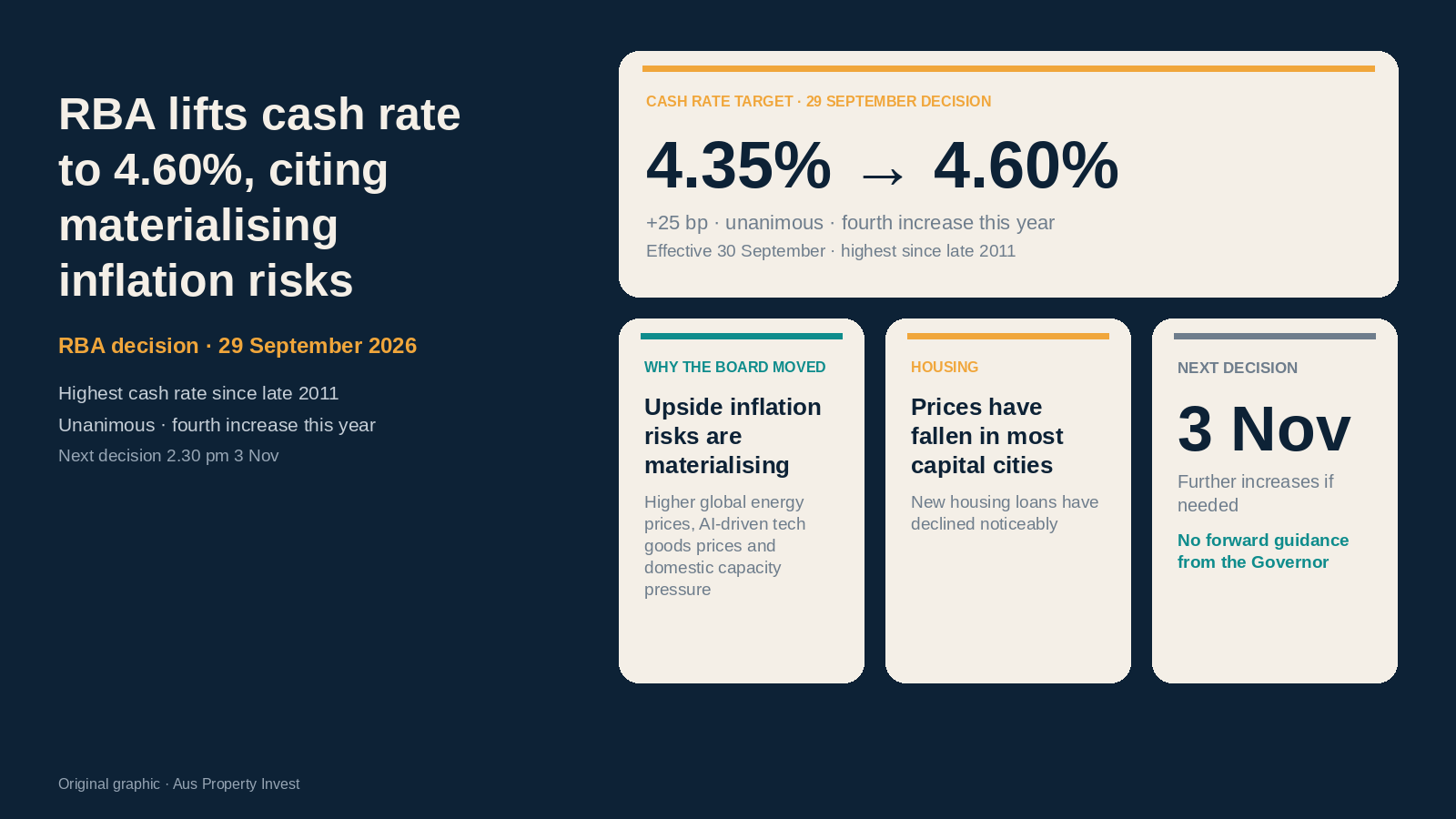
The Reserve Bank’s Monetary Policy Board raised the cash rate target by 25 basis points to 4.60 per cent on 29 September 2026, the highest setting since late 2011 and the fourth increase this year.
In media release 2026-27, the Board said inflation remains elevated and that some of the upside risks flagged in August are materialising. It pointed to a broader Middle East conflict and much higher global energy prices than assumed in the August forecasts, rapid growth in global technology-related goods prices driven by AI-related demand, and ongoing pressure on domestic capacity. Liaison indicated firms are facing cost pressures and are either raising prices or looking to do so. Short-term inflation expectations remain elevated, and recent Australian inflation outcomes were stronger than expected at the previous meeting. Today’s decision was unanimous. The new target is effective from 30 September, with the next scheduled update at 2.30 pm on 3 November (cash rate overview).
Softer housing, tighter policy path
The statement does not ignore the housing channel. Growth in output has slowed but was a little stronger than expected in the June quarter at the margin. Consumer spending is easing gradually as expected, the Board said, “although housing prices have fallen in most capital cities and new housing loans have declined noticeably.” Labour market conditions have eased broadly as expected, while business investment and debt growth remain strong.
That pairing matters for credit and servicing. Another 25 basis point rise tightens financial conditions further after three increases since the start of the year, lifting variable-rate repayments and reducing borrowing capacity into a spring market the Board itself describes as softer on prices and new lending. The Board judged that, despite those earlier tightenings and signs the economy is slowing, inflation is still too high and a further tightening is warranted to support a return of inflation to target in a reasonable period. It said it remains focused on ensuring high inflation does not become embedded, and that aggregate demand needs to stay subdued for a period to ease capacity pressures.
Looking ahead, the Board kept the door open. It will “continue to do what it considers necessary to bring inflation sustainably back to target, including increasing the cash rate target further if needed,” and will be attentive to the data and the evolving outlook. Uncertainties remain elevated: the Middle East conflict is unresolved, oil supply disruptions are still pushing up energy prices and inflation, and weak productivity continues to constrain potential growth. The Board also flagged uncertainties about the economic effects of the downturn in the housing market.
Bullock: hope four rises are enough, no November guidance
Governor Michele Bullock’s post-decision media conference ran from 3.30 pm AEST. The Reserve Bank has published the official transcript and audio, with a video stream also listed.
On the official record, Bullock said the Board’s hope is that the four cash rate increases this year will prove restrictive enough to bring inflation down, while refusing to give forward guidance on whether another move is needed at the 3 November meeting. “What is the hope here, is that this will be restrictive enough, those four interest rate increases, to bring things down. Now, will it be enough? I don’t know. I’m not going to give you forward guidance,” she said. She also stressed that much of the effect from the three earlier 2026 increases is still to flow through.
On the then-upcoming ABS inflation print, Bullock said the Board would not put a lot of emphasis on one number, even as underlying inflation has run around 3.5 per cent for about six months. She framed that pattern as history the Board cannot change, and said the task is to keep financial conditions tight enough that inflation pressure eases looking forward. “What’s of interest to us is where we’re going to be,” she said. She also said the Middle East conflict has been a big shock that has made Australia poorer, but that it is not the only reason for the decision: the economy started from a position of excess demand, which is why the Board began raising rates before the conflict, and productivity “is doing nothing.”
Those comments sit alongside, rather than rewrite, the written decision. The media release still says further increases remain available if needed. The presser tone leans on data dependence and the unfinished transmission of earlier tightenings, without locking in or ruling out a November move. August CPI has since printed at 4.0 per cent annual with trimmed mean steady at 3.6 per cent (our CPI note). Earlier primary trail for this meeting included the August hold and open door on further hikes (MR 2026-19), Bullock’s House Economics opening statement, and bank economics desks that had September in their base case (those remain bank views, not Board decisions). For the wider rates-and-housing map, see Rates vs roofs.
None of this is buy, sell, hold or refinance advice.
How this was reported
Written by Wire for Aus Property Invest. Decision figures and wording follow the linked RBA monetary policy decision and cash rate pages. Presser quotes and status follow the official RBA media conference transcript and audio page for 29 September 2026, with the video stream listed by the Bank. Secondary coverage was used only to locate those primaries before the official page went live. How we report: Wire.
General information only. Not financial, investment, legal or tax advice. See our Disclaimer.
Sources
- RBA Monetary Policy Decision, 29 Sep 2026 (MR 2026-27)
- RBA cash rate target overview
- RBA Media Conference Monetary Policy Decision, 29 Sep 2026 (official transcript/audio)
- RBA Speeches 2026 (Monetary Policy Decision media conference)
- RBA media conference video stream, 29 Sep 2026
- RBA Monetary Policy Decision, 11 Aug 2026 (MR 2026-19)
- RBA Coming Up