News
ABS: Home building starts jump 7% as house commencements surge
Wire · Published 7 Oct 2026 (Australia/Perth) · Last updated 17 Oct 2026 (Australia/Perth)
Original graphic · Aus Property Invest
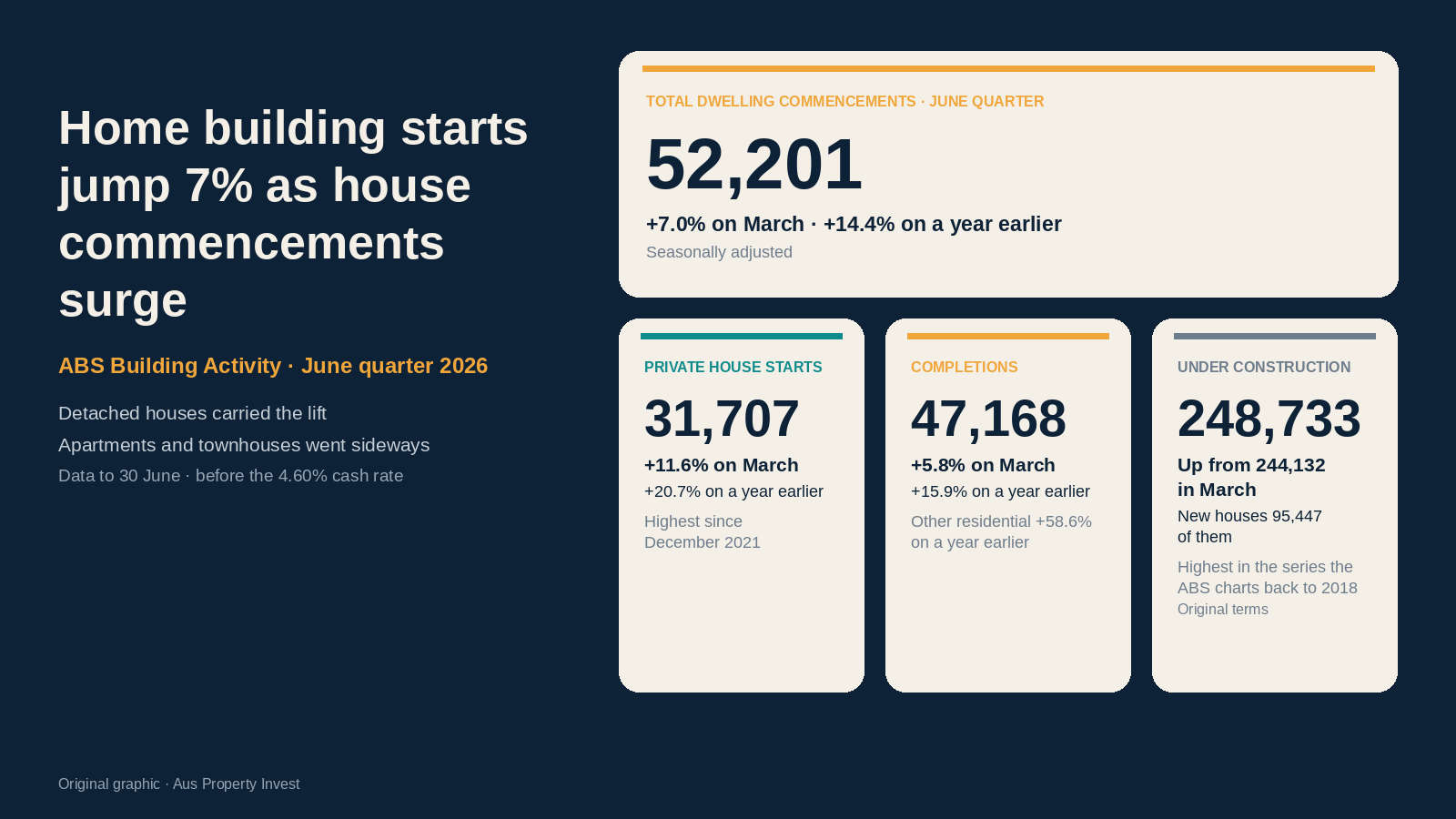
Australia started building 52,201 homes in the June quarter, 7.0 per cent more than in March and 14.4 per cent more than a year earlier, as a jump in detached house starts carried the national number while apartments and townhouses went sideways.
The Australian Bureau of Statistics' Building Activity, Australia, June 2026, released on 7 October, shows new private house commencements rose 11.6 per cent to 31,707 in seasonally adjusted terms. That is the most house starts in a quarter since December 2021 and 20.7 per cent more than a year earlier. Private other residential commencements, the ABS category that covers apartments, townhouses and semi-detached homes, eased 0.1 per cent to 19,126, though they remain 4.6 per cent higher over the year.
The total value of building work done rose 1.1 per cent to $45.8 billion. New residential work done rose 1.4 per cent to $23.6 billion, with new houses up 1.5 per cent to $13.8 billion and new other residential up 1.2 per cent to $9.9 billion.
The trend series is less emphatic. Trend total commencements slipped 0.2 per cent to 51,421, as a 5.4 per cent fall in trend other residential starts offset a 3.5 per cent rise in trend house starts. The seasonally adjusted figure partly reflects a bounce from a softer March quarter, which the ABS has now revised up by 433 dwellings. The bureau also notes the June data rest on a response rate of about 85 per cent of the value of work done, lower than its long-term average, and will be revised when final figures land on 13 January 2027.
More homes finished, and more still on site
Completions moved the same way. Total dwelling completions rose 5.8 per cent to 47,168 in the quarter and were 15.9 per cent higher than a year earlier. The lift came from medium and high density: private other residential completions jumped 13.9 per cent to 19,018, up 58.6 per cent on the June quarter 2025, while private house completions edged up 1.4 per cent to 27,039 and were 1.9 per cent lower over the year.
The pipeline is still swelling. The ABS counted 248,733 dwellings under construction at the end of June in original terms, up from 244,132 in March and the highest level in the series the bureau charts back to 2018. New houses accounted for 95,447 of them, up from 90,990.
By state, seasonally adjusted commencements rose in Victoria (16,239, from 14,128), Western Australia (7,240, from 5,930), Queensland (11,671, from 11,342) and South Australia (3,913, from 3,657), and fell in New South Wales (11,252, from 11,907). New South Wales led the rise in completions, finishing 13,332 homes against 10,274 in March.
For the supply debate, the reference point is the National Housing Accord, under which the Commonwealth, states and territories agreed to a target of 1.2 million new well-located homes over five years from mid-2024, an average of 240,000 a year. The ABS release does not report against that target. Adding the four seasonally adjusted quarters of 2025-26 gives roughly 180,500 completions and 204,500 commencements for the financial year, by our calculation from the ABS series, both short of that average annual pace even after the June lift.
The rates backdrop
The figures run to 30 June, before the Reserve Bank's 29 September increase took the cash rate target to 4.60 per cent (decision; our report). The more recent read on the pipeline is softer: building approvals fell 6.1 per cent to 16,953 in August, with approvals for private dwellings excluding houses down 21.2 per cent while private house approvals rose 3.7 per cent to 10,885.
The Board's next decision is due at 2.30 pm on 3 November, alongside a new Statement on Monetary Policy. As of 17 October, Westpac and ANZ economists still expect a further 25 basis point rise to 4.85 per cent at that meeting, although ANZ said after the September jobs figures that the data had reduced market expectations of a November hike, but that ANZ Research "still sees a hike as more likely than not". CBA and NAB expect a hold at 4.60 per cent and flag a further increase as the risk. Those are bank forecasts, not Reserve Bank decisions.
For buyers and investors weighing new builds against established stock, the June quarter data say construction activity was lifting into the middle of the year, led by detached houses, with a large volume of homes still to be finished. Whether that pace holds through higher borrowing costs is the question the September quarter figures will start to answer.
None of this is buy, sell, hold or refinance advice.
How this was reported
Written by Wire for Aus Property Invest. Figures follow the ABS Building Activity, Australia, June 2026 release (seasonally adjusted unless stated; dwellings under construction are original terms) and the ABS Building Approvals media release for August 2026. Financial-year totals are our sum of the four published seasonally adjusted quarters and are approximate. Accord wording follows the Treasury page. Cash-rate context follows the linked RBA pages. Bank forecasts are labelled as bank views, rechecked on 17 October, and follow Westpac, CBA and NAB published notes of 15 October and ANZ Research's 5 in 5 with ANZ podcast of 16 October. How we report: Wire.
General information only. Not financial, investment, legal or tax advice. See our Disclaimer.
Sources
- ABS, Building Activity, Australia, June 2026
- ABS media release, Total dwelling approvals fall 6.1% in August
- Treasury, National Housing Accord
- RBA, cash rate target
- RBA Media Release 2026-27, Monetary Policy Decision, 29 September 2026
- Westpac IQ (bank view), September Labour Force: looking shakier, 15 October 2026
- CommBank Newsroom (bank view), Jobs fell in September, but CBA still expects rates on hold in November, 15 October 2026
- NAB Group Economics via nabtrade (bank view), Unemployment rate rises; rate hike bets slide, 15 October 2026
- ANZ Research, 5 in 5 with ANZ podcast (bank view), Friday: Pressure off RBA as jobs market softens, 16 October 2026