News
Jobs fall 39,300 as unemployment rate reaches 4.7% before RBA's November call
Wire · Published 15 Oct 2026 (Australia/Perth) · Last updated 18 Oct 2026 (Australia/Perth)
Original graphic · Aus Property Invest
Australia’s labour market softened sharply in September, with employment falling and the unemployment rate rising to 4.7 per cent, giving the Reserve Bank a weaker jobs backdrop for its 3 November cash-rate decision than markets and bank economists had expected.
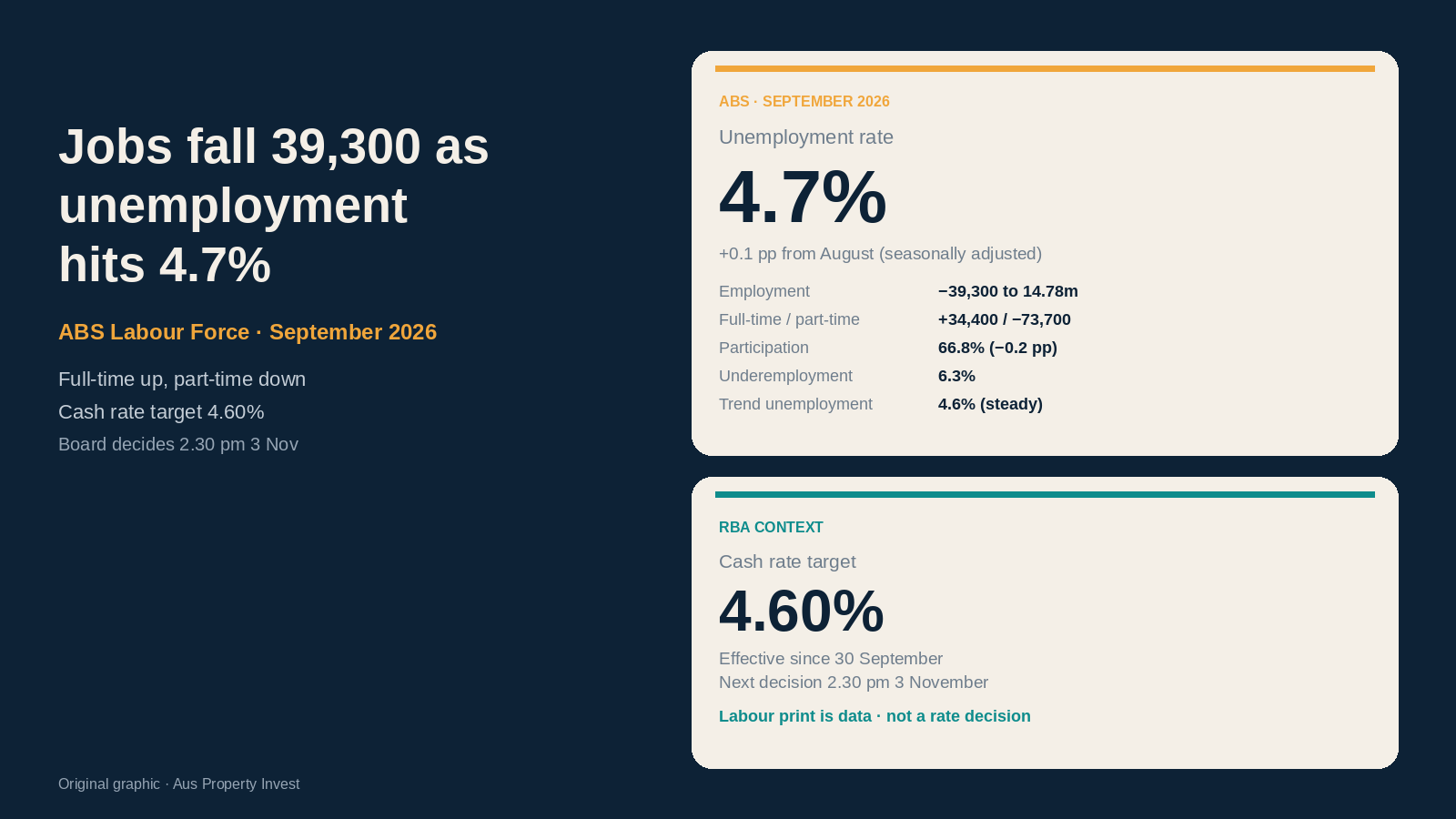
Seasonally adjusted figures from the Australian Bureau of Statistics' Labour Force, Australia, September 2026 show employment down 39,300 people to 14.78 million. Full-time employment rose by about 34,400, while part-time employment fell by about 73,700. The number of unemployed people increased by about 8,900 to 732,000, and the ABS reports the unemployment rate up 0.1 percentage points to 4.7 per cent. August was revised up and also rounds to 4.7 per cent in the ABS seasonally adjusted series, so the rise shows only in the unrounded figures. The employment-to-population ratio fell 0.3 percentage points to 63.6 per cent, and the participation rate fell 0.2 percentage points to 66.8 per cent. Underemployment edged up to 6.3 per cent and underutilisation to 11.0 per cent. Monthly hours worked still rose slightly, by about 1 million hours to 2.011 billion.
None of that is a monetary policy decision. The cash rate target remains 4.60 per cent, effective since 30 September (September hike), and only the Board statement due at 2.30 pm on 3 November changes that.
ABS head of labour statistics Sean Crick said there were about 39,000 fewer employed people and about 9,000 more unemployed people in the month, and that a higher proportion of people remained unemployed than in recent years. The bureau flags residual influence from Labour Force Modernisation and Supplementary Survey changes on seasonally adjusted monthly moves, and continues to recommend trend estimates as the better guide to the underlying market. In trend terms, unemployment stayed at 4.6 per cent and employment rose about 15,700.
Western Australia’s seasonally adjusted unemployment rate was 4.2 per cent in September, down 0.2 percentage points on the month, with participation at 69.1 per cent.
Softer jobs into a hawkish path
The print lands after September minutes that cast the 29 September hike as unanimous and left a further increase on the table. Those minutes said the Board only briefly considered a hold, judged excess demand greater than previously assessed, and noted that returning inflation to target amid persistent supply shocks could mean accepting slower growth in demand and employment. Staff had already been questioning whether the unemployment rate consistent with the inflation target is higher than previously thought.
A 39,300 fall in employment, against a market expectation of a 20,000 rise cited by Westpac and CBA, and a jobless rate at 4.7 per cent, pull against that hawkish frame without settling the inflation side of the dual mandate. August CPI remains the last monthly inflation print, with headline annual CPI at 4.0 per cent; September CPI is due on 28 October, still before the November meeting.
Bank economics views are forecasts, not Board decisions. Before the release, Westpac and ANZ had a November hike to 4.85 per cent as their base case, while CBA and NAB favoured a hold with hike risk live. Westpac's October Market Outlook, published on the morning of the release, says the RBA "looks set to follow up in November". After the print, ANZ senior economist Jasmine Zheng said on ANZ's 5 in 5 podcast that the data had reduced market expectations of a November hike, but that ANZ Research still sees a hike as more likely than not. CBA senior economist Ashwin Clarke said the bank still expects a hold but that "another hike is plausible", and that the Board was likely to put less weight than usual on the month's figures after the ABS flagged possible survey effects. Westpac said after the release that it still expects a 25 basis point hike in November, and NAB that it continues to expect a hold while acknowledging the risk sits with a hike. As of 17 October, that leaves Westpac and ANZ expecting a rise to 4.85 per cent and CBA and NAB a hold at 4.60 per cent.
What it means for mortgage holders
For households and the property market, a cooler labour print usually weighs on income confidence and demand, even while hours worked hold up and full-time employment rises on the month. Mortgage holders already face a cash rate at 4.60 per cent after four increases this year; another November hike would lift variable repayments again into late spring, while a hold would leave the September path intact until CPI and the Statement on Monetary Policy. Softer employment and higher unemployment sit alongside the Board’s own minutes reading that housing prices had fallen faster than expected and investor lending had dropped sharply, without that being enough to stop the September hike.
None of this is buy, sell, hold or refinance advice.
How this was reported
Written by Wire for Aus Property Invest. All labour figures follow the ABS September 2026 Labour Force release and media statement. RBA cash-rate and minutes references are primary. Bank reactions are labelled as economics views, rechecked on 17 October against Westpac, CBA and NAB published notes and ANZ Research's 5 in 5 with ANZ podcast of 16 October. How we report: Wire.
General information only. Not financial, investment, legal or tax advice. See our Disclaimer.
Sources
- ABS, Labour Force, Australia, September 2026
- ABS media release: Unemployment rate at 4.7% in September
- RBA cash rate target
- RBA Monetary Policy Decision, 29 Sep 2026 (MR 2026-27)
- RBA Minutes, 29 September 2026 meeting
- RBA Coming Up
- Westpac IQ (bank view), Westpac Market Outlook, October 2026, 15 October 2026
- Westpac IQ (bank view), September Labour Force: looking shakier, 15 October 2026
- CommBank Newsroom (bank view), Jobs fell in September, but CBA still expects rates on hold in November, 15 October 2026
- NAB Group Economics via nabtrade (bank view), Unemployment rate rises; rate hike bets slide, 15 October 2026
- ANZ Research, 5 in 5 with ANZ podcast (bank view), Friday: Pressure off RBA as jobs market softens, 16 October 2026