News
Housing ministers agree to overhaul the National Construction Code
Wire · Published 23 Oct 2026 (Australia/Perth) · Last updated 23 Oct 2026 (Australia/Perth)
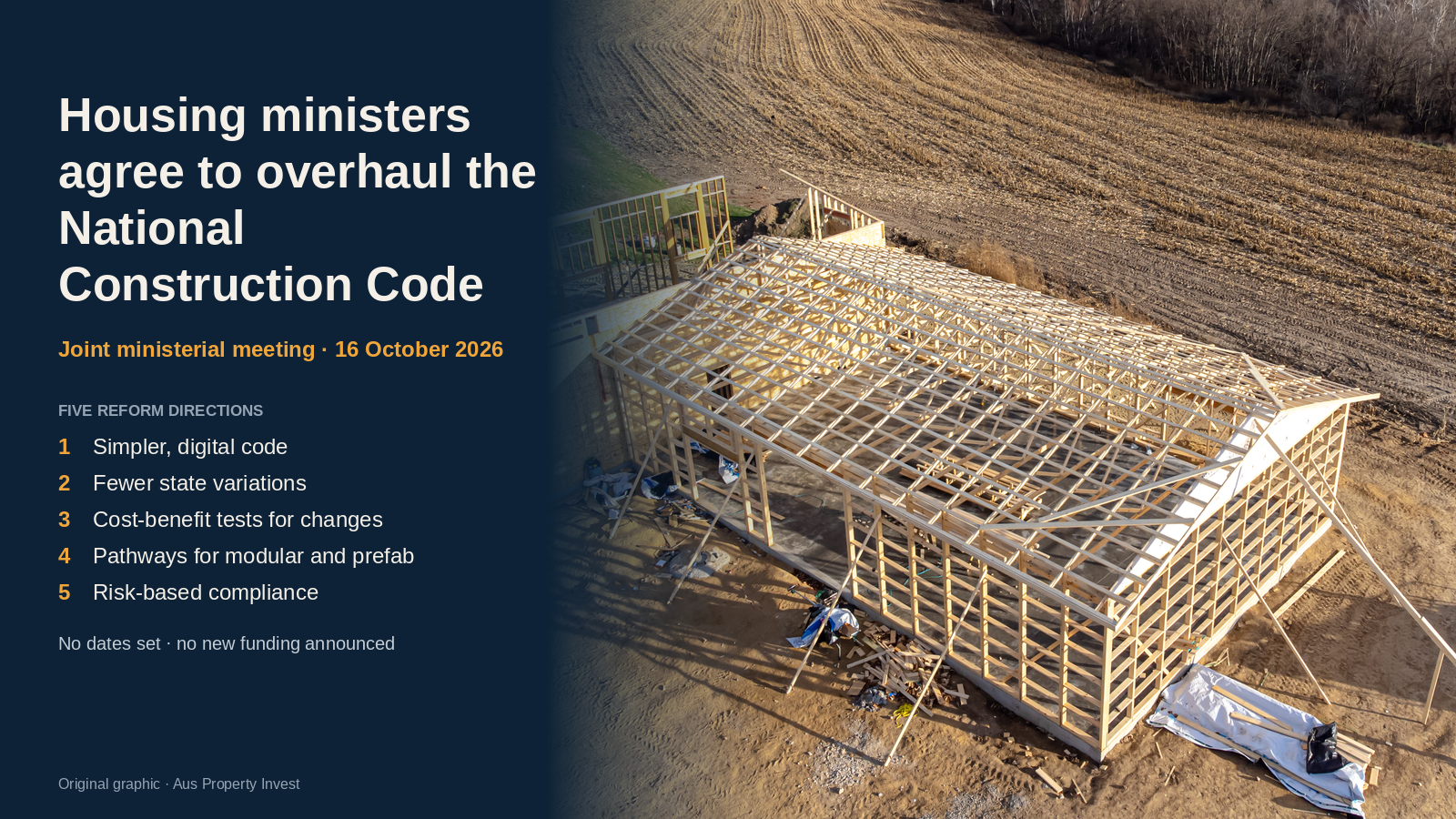
Photo: Wikideas1 / Wikimedia Commons (CC0)
Australia's housing, planning and building ministers agreed on 16 October to rework the National Construction Code, the national rulebook every new home is built to, in a bid to lift construction productivity and get more homes finished faster.
The commitment came out of the second Joint Ministerial Meeting on Housing Supply and Affordability, held at Parliament House in Canberra. In a communiqué published by Treasury, Commonwealth, state and territory ministers described the code overhaul as "a once-in-a-generation opportunity to transform how Australia builds", and signed a shared statement setting out five reform directions.
Those directions are broad rather than prescriptive. Jurisdictions agreed to make the code simpler and easier to use, with the Australian Building Codes Board, the body that writes the code, starting preliminary work on digital delivery, clearer language and stripping out outdated, duplicated and inconsistent provisions. They recommitted to a single national market by analysing the variations states and territories make to the code. They agreed that future code decisions should be backed, where practical, by "transparent, fit-for-purpose cost-benefit analysis", including the impact on the commercial feasibility of new housing. They also agreed to build nationally consistent pathways for innovative products and methods, including modular and prefabricated construction, and to design risk-based, proportionate ways for builders to demonstrate compliance depending on the type and complexity of a building.
The communiqué sets no dates for any of these changes, and no new funding was announced.
Where this sits
The code work builds on decisions made a year ago. In October 2025, building ministers agreed to pause further residential changes to the code until mid-2029, other than essential quality and safety measures, and to start streamlining it. Treasury ran a consultation on that streamlining, with submissions closing in February 2026, according to its building and construction page.
Ministers also heard from Productivity Commission chair Danielle Wood on the Commission's interim report on housing supply regulation, released on 27 July. That report found relaxing land-use controls and better coordinating enabling infrastructure were likely to do the most for supply and affordability. It makes no recommendations yet; the final report is due to government by March 2027.
On supply, ministers pointed to recent data as evidence construction has strengthened, citing dwelling completions up 15.9 per cent over the year to the June quarter and a record 248,733 homes under construction. Those figures match the ABS Building Activity release for the June quarter (our June quarter building activity report). Ministers also said building approvals in August were 10.3 per cent higher than a year earlier. The monthly picture was softer: the ABS reported total approvals fell 6.1 per cent in August from July, driven by a drop in apartments and townhouses (our August CPI and approvals report).
The benchmark remains the National Housing Accord target of 1.2 million new well-located homes over five years from mid-2024, or about 240,000 a year. The communiqué does not report progress against that number. By our earlier calculation from the ABS seasonally adjusted series, completions in 2025-26 came to roughly 180,500.
Ministers "noted" the Commonwealth's $2 billion Local Infrastructure Fund, announced in the 2026-27 Budget to pay for roads, water, sewerage and power connections for new housing, which the government says will unlock up to 65,000 homes over a decade. Treasury says applications for the first round are expected to open later in 2026.
On social and affordable housing, the communiqué says more than 8,000 homes have been completed under the Commonwealth's 55,000-dwelling target, with more than 11,000 under construction and more than 10,000 in planning or pre-construction. Ministers agreed to renewed national work on affordable housing policy, including regulatory reform for community housing providers and a common national framework. After the meeting, ministers held a roundtable with investors, modular manufacturers, unions and builders on modern methods of construction.
For buyers and investors, the communiqué changes nothing immediately. It is a statement of intent, and the code itself will only change as the building codes board and each jurisdiction do the work. The more immediate cost pressure is still borrowing: the Reserve Bank's cash rate target is 4.60 per cent, and the Board's next decision is due on 3 November.
None of this is buy, sell, hold or refinance advice.
How this was reported
Written by Wire for Aus Property Invest. Meeting outcomes, quotes and figures attributed to ministers follow the Treasury communiqué of 16 October 2026. Construction figures were checked against the ABS June quarter Building Activity release and the August Building Approvals media release. The Accord pace comparison is our sum of the four published seasonally adjusted quarters of 2025-26 and is approximate. Background follows the linked Treasury, Productivity Commission and RBA pages. How we report: Wire.
General information only. Not financial, investment, legal or tax advice. See our Disclaimer.
Sources
- Treasury, Meeting communiqué: Joint Ministerial Meeting on Housing Supply and Affordability, October 2026
- Treasury, Meeting communiqué: Building Ministers' Meeting, October 2025
- Treasury, Building and construction
- Treasury, Local Infrastructure Fund
- Treasury, National Housing Accord
- Productivity Commission, Housing supply regulation: interim report
- ABS, Building Activity, Australia, June 2026
- ABS media release, Total dwelling approvals fall 6.1% in August
- RBA, cash rate target