News
CPI climbs to 4.0% as housing and fuel lift inflation a day after the RBA hike
Wire · Published 1 Oct 2026 (Australia/Perth) · Last updated 1 Oct 2026 (Australia/Perth)
Original graphic · Aus Property Invest
Annual consumer inflation climbed back to 4.0 per cent in August, a day after the Reserve Bank lifted the cash rate, as housing costs and a sharp fuel rebound outweighed a still-sticky but unchanged underlying measure.
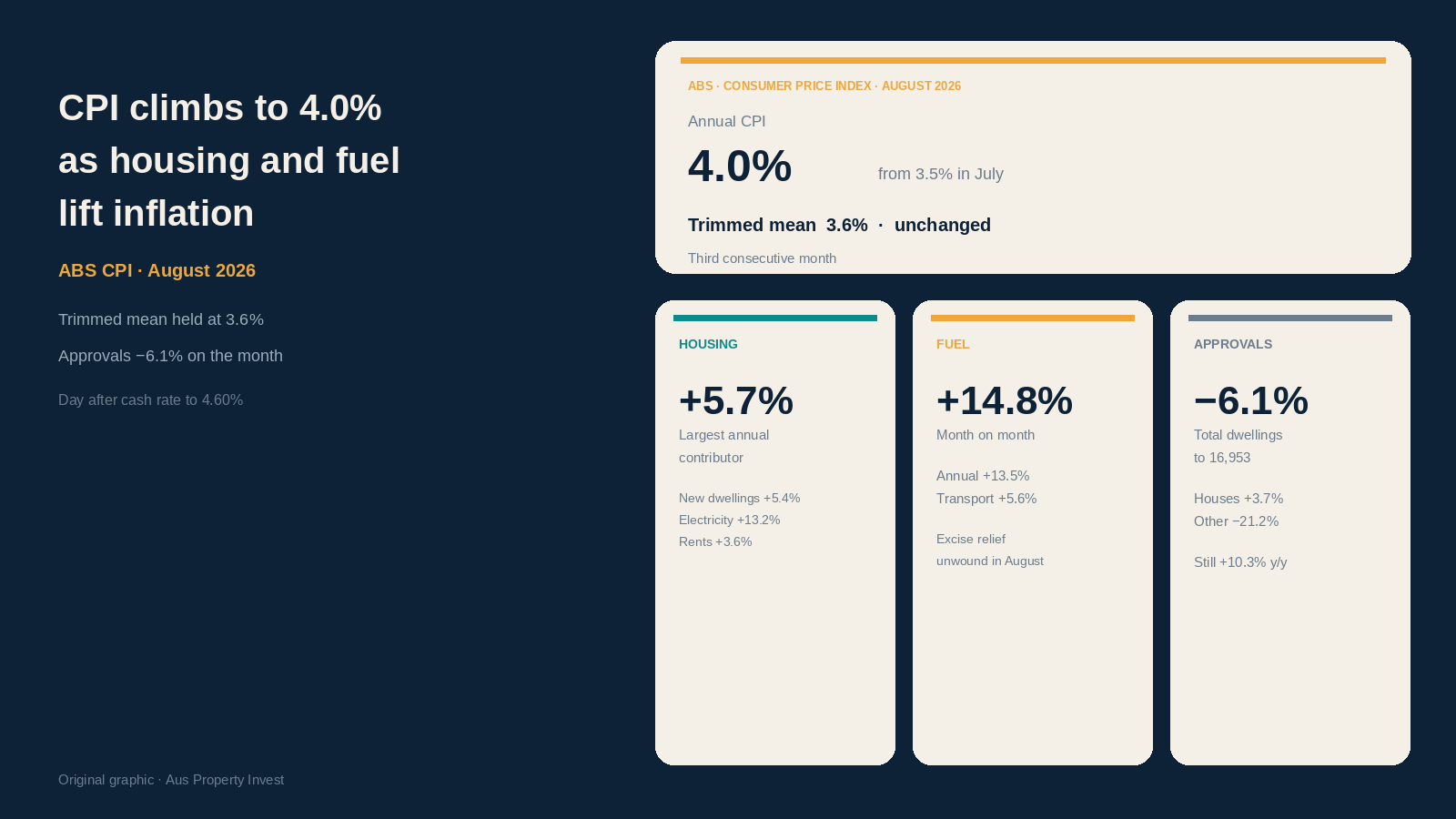
Figures from the Australian Bureau of Statistics Consumer Price Index show the all-groups CPI rose 4.0 per cent in the 12 months to August 2026, up from 3.5 per cent in July. In the month, prices rose 0.4 per cent in original terms and 0.7 per cent seasonally adjusted. Trimmed mean inflation, the Board’s preferred underlying gauge, was 3.6 per cent through the year, unchanged for a third consecutive month. The ABS media release said housing was the largest annual contributor, rising 5.7 per cent, with transport second at 5.6 per cent.
Housing costs still the main drag for households
That housing print is the property stake. Annual housing inflation rose from 5.0 per cent in July to 5.7 per cent in August. New dwelling prices were up 5.4 per cent through the year as project home builders passed on higher labour and materials costs, electricity jumped 13.2 per cent as Commonwealth rebate timing dropped out of the annual comparison, and rents rose 3.6 per cent, unchanged since May. For landlords and tenants, rents are still rising, but slower than new-build and power costs. For the rates story, a housing group still near 6 per cent annual keeps domestic price pressure visible after four cash-rate increases this year.
Automotive fuel was the other swing factor. Prices rose 14.8 per cent in the month, the ABS said, driven by higher world oil prices and the unwinding of the remainder of the federal fuel excise relief measures in August. Through the year, automotive fuel was up 13.5 per cent and the broader transport group 5.6 per cent. Goods inflation lifted to 4.2 per cent annually; services held at 3.7 per cent. Among the capitals, Hobart (4.8 per cent), Adelaide (4.7 per cent) and Darwin (4.5 per cent) led the annual CPI, with Perth at 4.3 per cent, Brisbane and Canberra at 4.1 per cent, Sydney at 3.9 per cent and Melbourne the softest at 3.5 per cent.
A day after 4.60%, and soft approvals on the side
The timing matters. On 29 September the Monetary Policy Board raised the cash rate target by 25 basis points to 4.60 per cent, effective 30 September (MR 2026-27; our write-up). The Board said upside inflation risks flagged in August are materialising and left open further increases if needed. At the post-decision media conference, now on the official RBA transcript, Governor Michele Bullock said the hope is that the four 2026 increases prove restrictive enough, refused forward guidance on the 3 November meeting, and said the Board would not put heavy weight on a single CPI print. “What’s of interest to us is where we’re going to be,” she said. That is Board language, not a bank forecast.
Same-day Building Approvals show the pipeline cooling at the margin without reversing the year-earlier gain. Seasonally adjusted total dwellings approved fell 6.1 per cent to 16,953 in August, still 10.3 per cent higher than a year ago. Private sector houses rose 3.7 per cent to 10,885, an eighth straight month above 10,000, while private dwellings excluding houses fell 21.2 per cent to 5,674, led by weaker apartment approvals in Queensland. Residential building value edged down 0.6 per cent to $11.30 billion; non-residential value fell sharply after a strong July. Approvals are not a Board decision and do not rewrite the inflation path, but they sit beside the Governor’s point that high-density economics remain tight while the market softens. August household spending was already flat once fuel is stripped out (MHSI note).
For households and investors, a 4.0 per cent headline print with housing still the largest annual contributor lands into a higher cash-rate setting and a spring market the Board itself describes as softer on prices and new loans. Trimmed mean holding at 3.6 per cent keeps the underlying story sticky rather than accelerating; fuel and electricity explain much of the headline jump. Bank economics desks remain split on whether November needs another move, and those remain bank views, not a Board decision. The next scheduled cash-rate update is 2.30 pm on 3 November. For the wider rates-and-housing map, see Rates vs roofs.
None of this is buy, sell, hold or refinance advice.
How this was reported
Written by Wire for Aus Property Invest. CPI, housing-group and fuel figures follow the linked ABS August 2026 CPI release and media release. Building approvals figures follow the linked ABS August 2026 Building Approvals release. RBA decision and presser quotes are labelled and linked to the primary media release and official media conference page. Bank path comments are labelled as bank views only. How we report: Wire.
General information only. Not financial, investment, legal or tax advice. See our Disclaimer.
Sources
- ABS, Consumer Price Index, Australia, August 2026
- ABS media release: CPI rose 4.0% in the year to August 2026
- ABS, Building Approvals, Australia, August 2026
- ABS media release: Total dwelling approvals fall 6.1% in August
- RBA Monetary Policy Decision, 29 Sep 2026 (MR 2026-27)
- RBA Media Conference Monetary Policy Decision, 29 Sep 2026
- RBA cash rate target overview
- RBA Coming Up