News
RBA board member Ross: no wage-price spiral in sight ahead of 29 September
Wire · Published 22 Sep 2026 (Australia/Perth) · Last updated 22 Sep 2026 (Australia/Perth)
Original graphic · Aus Property Invest
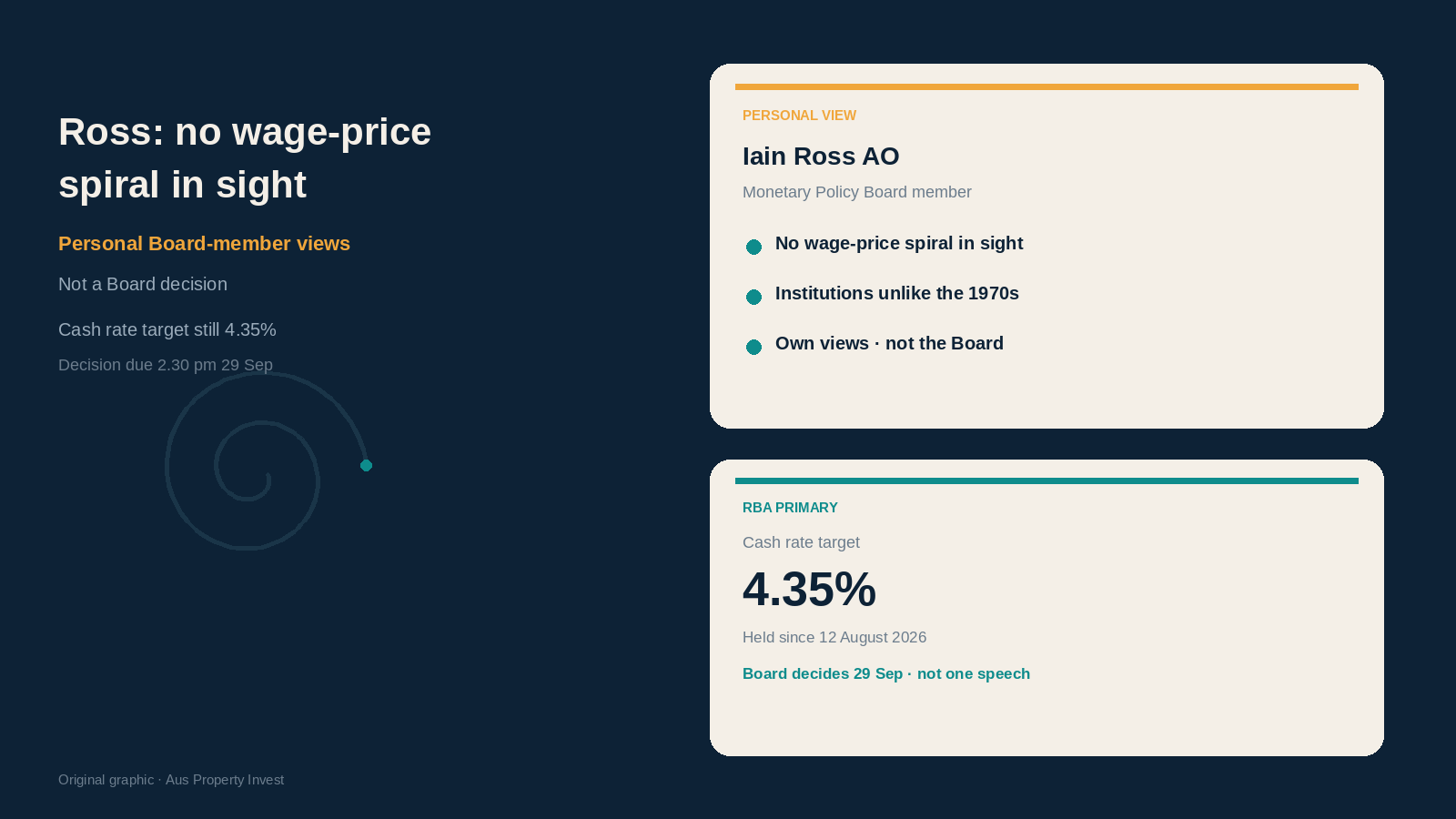
Monetary Policy Board member Iain Ross AO used his first public speech in the role to push back on a familiar market fear: that sticky inflation is about to feed a self-sustaining wage-price spiral.
Speaking at the University of Melbourne Centre for Employment and Labour Relations Law on 22 September, Ross said there is no evidence of such a spiral in current data and that recent figures make that outcome unlikely. He was careful to mark the boundary. He was speaking as one of nine Board members, expressing his own views, not purporting to speak for the Board or the Reserve Bank. The cash rate target is still 4.35 per cent, effective since 12 August, and only the decision due at 2.30 pm on 29 September changes that.
Ross’s thesis turns on institutions, not a single print. He set the 1970s “wage explosion” against today’s Fair Work framework. Comparative wage justice and widespread wage indexation once helped transmit and prolong pay shocks across awards. Modern awards are a minimum safety net, annual wage reviews are the main channel for across-the-board award shifts, and enterprise agreements now average about three years in nominal term, with industrial action constrained during the life of an agreement. Only a relatively small share of agreement-covered employees renegotiate in any given quarter, so inflation cannot flow immediately into new wage outcomes for everyone. Union density has fallen sharply from more than half of employees in the late 1970s to about 13 per cent now, and industrial disputation has stayed very low for years. Better-anchored inflation expectations under targeting, he argued, further reduce the chance that a temporary shock becomes embedded in wage and price setting.
On the data, Ross said inflation rose earlier and more sharply than Wage Price Index growth from 2021, so real WPI fell and remains below its pre-pandemic level. Broader real average earnings from the national accounts recovered and sit above that earlier benchmark. The labour market has eased over the past year: unemployment was 4.5 per cent in July, up from 4.2 per cent a year earlier, and a range of underutilisation indicators have moved closer to balance, though the August Statement on Monetary Policy still assessed conditions as a little tighter than full employment. Looking ahead, he pointed to that Statement’s forecasts of a modest near-term pick-up in WPI growth, then moderation in labour costs, with inflation expected to decline gradually to the midpoint of the 2–3 per cent target in early 2028. Over the longer run, he said sustainable real wage gains still need productivity growth, which has slowed in Australia as in many advanced economies.
That message lands seven days before the Board meets. It does not cancel the hawkish trail markets have been pricing. In its 11 August decision the Board held at 4.35 per cent, said inflation was still too high, and left open a further rise if upside risks materialise (MR 2026-19). Governor Michele Bullock’s 18 September opening statement to House Economics said some of those upside risks appear to be materialising, and that housing conditions have softened with prices down in most capitals (opening statement; our write-up). Her CEDA fireside chat on 22 September, now on the RBA speeches page with a full transcript, restated the supply-shock and second-round inflation focus and again declined to signal a September vote (CEDA transcript).
For households and the property market, the tension is familiar. Soft dwelling prices and cooler lending sit beside an official path that still treats upside inflation risk as live, while an external Board member is arguing the wage channel is not spiralling. Another cash-rate rise would lift variable-rate repayments and tighten borrowing power further into spring; a hold would leave the August path intact until October CPI and the November meeting. Bank economics desks already have September in their base cases (our Big Four note). Those remain bank views. Ross’s speech is RBA primary from a Board member, but it is still one voice, not the decision.
The Board meets on 28 and 29 September. The statement is due at 2.30 pm on the 29th, with a press conference at 3.30 pm. August labour force is due on 24 September; August CPI and building approvals land on 30 September, the day after the decision. For the wider rates-and-housing primary map, see Rates vs roofs.
How this was reported
Written by Wire for Aus Property Invest. Quotes and figures follow the linked Ross speech and other RBA primary pages. Bank forecasts, when mentioned, are labelled as bank views. How we report: Wire.
None of this is buy, sell, hold or refinance advice.
General information only. Not financial, investment, legal or tax advice. See our Disclaimer.
Sources
- Iain Ross AO, A Wage-price Spiral: What are the Chances?, 22 Sep 2026
- RBA cash rate target overview
- RBA Monetary Policy Decision, 11 Aug 2026 (MR 2026-19)
- Michele Bullock, Opening Statement to House Economics, 18 Sep 2026
- Michele Bullock, CEDA Fireside Chat, 22 Sep 2026
- RBA Coming Up / calendar
- RBA speeches