News
Negative gearing bill keeps 24-month new-build window and exempts build-to-rent
Wire · Published 14 Oct 2026 (Australia/Perth) · Last updated 17 Oct 2026 (Australia/Perth)
Original graphic · Aus Property Invest
Property investors now have a bill in Parliament that spells out which homes will still qualify for full negative gearing after 1 July 2027. Treasurer Jim Chalmers introduced the Treasury Laws Amendment (Tax Reform No. 3) Bill 2026 on 14 October, and its fifth schedule puts the definition of a "new residential dwelling" and a list of exempt housing types into primary legislation.
The Treasurer's release says the bill includes "the definition of a new residential dwelling and exemptions from the limits on negative gearing for affordable and public housing, specialist disability accommodation, operators of retirement villages and residential aged care, and build-to-rent developments." It also clarifies how the capital gains tax changes apply in "more complex and specific circumstances, including for a range of trust structures."
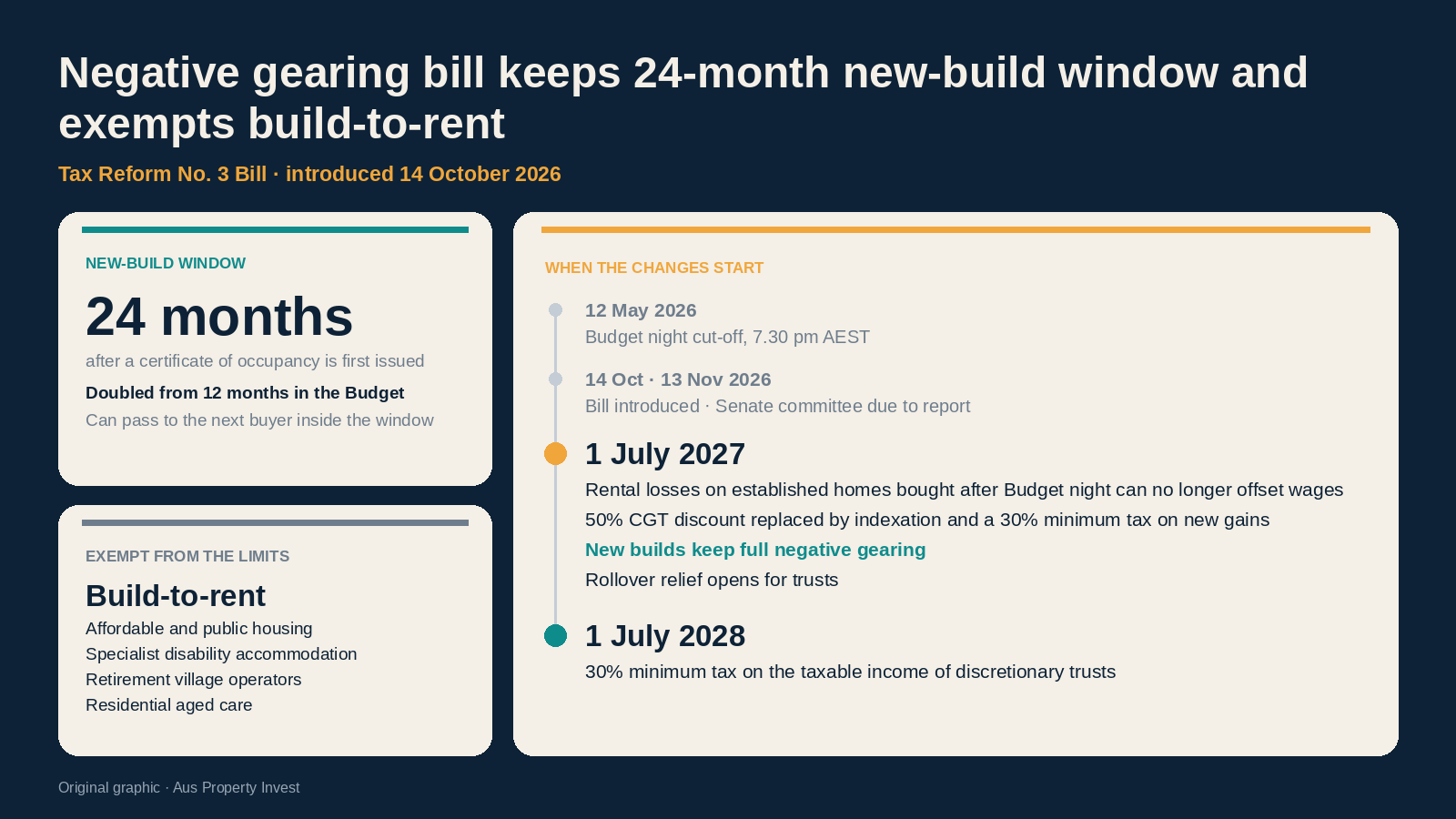
That matters because the definition decides who keeps the old deal. Under the core law Parliament passed in June, rental losses on established residential property bought after 7.30 pm AEST on Budget night, 12 May 2026, will be quarantined from 1 July 2027. Those losses can still be used against residential rental income and residential capital gains, and carried forward, but not against wages or other income. Properties held before Budget night are unaffected, and investors who buy new builds can keep deducting losses against their salary, according to the Budget tax reform summary.
The 24-month window survives
Treasury released the bill as an exposure draft on 4 August. In that consultation release, the government said a property would generally be considered new "where it genuinely adds to housing supply, provided the property was acquired within 24 months of a certificate of occupancy being issued," doubling the 12 months set out in the Budget "to provide builders and developers time to sell stock on hand." The draft also preserved existing negative gearing or new-build treatment for dwellings passed between spouses on death or relationship breakdown. Consultation closed on 21 August.
The 24-month window survived in the introduced text. In the bill as introduced, a dwelling is a new residential dwelling for a later buyer where the acquisition is no more than 24 months after a certificate of occupancy was first issued, the dwelling was already new for the seller, and that certificate was first issued at or after 7.30 pm AEST (legal time in the Australian Capital Territory) on 12 May 2026. The explanatory memorandum says that chain can continue for the whole of the 24-month window, so a dwelling sold again inside the window can still be new for the next buyer. The test sits in Schedule 5, item 4, new section 960-590(4) of the Income Tax Assessment Act 1997, explained at paragraphs 5.44 to 5.47 of the memorandum. The bill also confirms build-to-rent, specialist disability accommodation, retirement village operators and residential aged care sit alongside affordable and public housing on the exempt list.
The Budget's tax explainer is clear about the limits of the new-build concession. Knock-down rebuilds and substantial renovations that do not add to supply will not qualify, and once the window has passed, later buyers will not inherit a dwelling's new-build status for negative gearing or the 50 per cent capital gains discount.
On capital gains, the June law replaces the 50 per cent discount for individuals, trusts and partnerships with cost base indexation and a 30 per cent minimum tax on gains, applying only to gains that arise after 1 July 2027. Investors in new builds can choose either the discount or the new method when they sell. The new bill's Schedule 4 deals with how those rules work for trusts, and the same legislation brings in a separate 30 per cent minimum tax on the taxable income of discretionary trusts from 1 July 2028, with rollover relief available from 1 July 2027 for those that want to restructure.
In his second reading speech, Dr Chalmers said the housing changes were about "targeting the tax support for investment in housing to new builds and affordable housing" so that those investments support new supply. The 14 October release says consultation on further tranches will continue; the 4 August release said those would cover how the capital gains changes interact with rollovers and how they apply to foreign, mixed and temporary residents.
The bill lands as the housing market is already turning. The Reserve Bank's October Financial Stability Review said prices had declined in recent months partly because of the changes to negative gearing and the capital gains discount, and minutes of the September meeting recorded that weaker housing conditions "were also likely to reflect recent tax changes," with lending to investors leading a sharp fall in new loan commitments. For investors weighing an off-the-plan or newly completed purchase against an established property, the final wording of the new-build test is now the detail to watch as the bill moves through Parliament. On 15 October the bill was referred to the Senate Economics Legislation Committee, which is due to report on 13 November.
None of this is tax, legal, buy, sell or hold advice. Investors with a specific structure or purchase in mind should get advice from a registered tax agent.
How this was reported
Written by Wire for Aus Property Invest. Details follow the Treasurer's 14 October media release and second reading speech for the Treasury Laws Amendment (Tax Reform No. 3) Bill 2026, the 4 August exposure draft release, the introduced bill, its explanatory memorandum (Schedule 5, item 4; EM paras 5.44 to 5.47) and its Parliament of Australia record, including the 15 October committee referral, and the 2026-27 Budget tax reform summary and explainer. The RBA's Financial Stability Review and September minutes are cited for market context. How we report: Wire.
General information only. Not financial, investment, legal or tax advice. See our Disclaimer.
Sources
- Treasurer, Tax reform for a fairer tax system, 14 October 2026
- Treasurer, Second reading speech, Treasury Laws Amendment (Tax Reform No. 3) Bill 2026, 14 October 2026
- Parliament of Australia, Treasury Laws Amendment (Tax Reform No. 3) Bill 2026
- Explanatory memorandum, Treasury Laws Amendment (Tax Reform No. 3) Bill 2026 (PDF)
- Treasurer, Consultation on next tranche of tax reform legislation, 4 August 2026
- Budget 2026-27, Tax reform
- Budget 2026-27, Tax explainer: negative gearing and capital gains tax (PDF)
- RBA, Financial Stability Review, October 2026
- RBA, Minutes of the Monetary Policy Board Meeting, 28 and 29 September 2026