News
RBA minutes: faster house price falls were not enough to stop the September hike
Wire · Published 13 Oct 2026 (Australia/Perth) · Last updated 17 Oct 2026 (Australia/Perth)
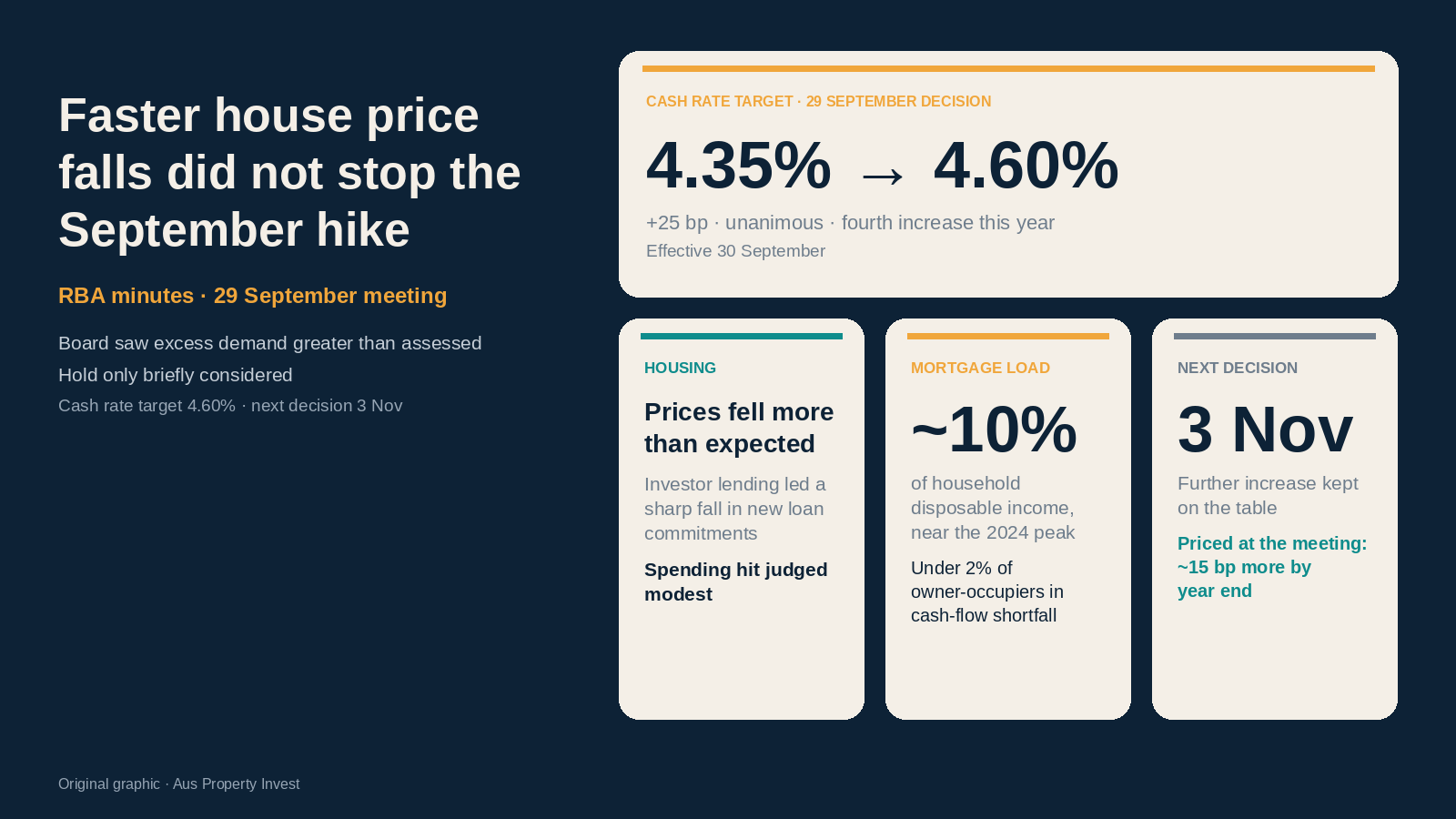
Original graphic · Aus Property Invest
The Reserve Bank's Monetary Policy Board knew house prices were falling faster than its own forecasts when it lifted the cash rate to 4.60 per cent on 29 September, and decided that was not a reason to hold, minutes of the 29 September meeting released on 13 October show.
The minutes, published at 11.30 am AEDT, record that "housing prices had declined by more than expected and new housing loan commitments had fallen sharply, led by lending to investors." Members said tighter monetary policy was contributing, but that weaker housing conditions "were also likely to reflect recent tax changes and some reversal of the earlier strong rise in housing prices." RBA staff now expect the cumulative fall in established prices to be greater than assumed in the August forecasts.
That downgrade did not move the Board. Members "briefly considered" the case for leaving rates unchanged, and one of the arguments was that falling housing prices might hit household spending harder than assumed. They set it aside. Staff scenario analysis suggested "even relatively large falls in housing prices would have only modest direct effects on activity and spending," and members noted the wealth effect on consumption tends to be "relatively modest." The decision to raise the cash rate by 25 basis points was unanimous, the fourth increase this year.
Why the Board leaned harder
The 29 September statement had already said upside risks to inflation were materialising. The minutes go further. Members concluded that "excess demand in the economy was greater than members had previously assessed," pointing to stronger-than-expected July inflation in market services, liaison reports of broad cost pressures, business investment up more than 10 per cent over the year and leading labour indicators that were broadly stable rather than weakening.
Staff are also questioning whether the unemployment rate consistent with the inflation target is higher than previously thought, which would mean the economy is running tighter than it looks with unemployment at 4.6 per cent. Their preliminary read of the July data was that the upside surprise in underlying inflation more likely reflected domestic capacity pressure than pass-through from Middle East energy costs. Members judged the risk of "persistently elevated inflation" had increased.
The Board also flagged a less comfortable trade-off. Executing its strategy amid more persistent supply shocks "would require accepting slower growth in demand and employment than would otherwise be the case," the minutes say. Members noted tentative signs the neutral interest rate in Australia had shifted higher again, and said that if market signals of a higher global neutral rate were right, the pre-hike cash rate of 4.35 per cent was less restrictive than it had been two years earlier.
For mortgage holders the minutes put repayments in plain numbers. Scheduled mortgage payments have risen to around 10 per cent of household disposable income, near their 2024 peak, while extra payments into offset and redraw accounts are a little below their longer run average. In the semi-annual financial stability discussion, members estimated fewer than 2 per cent of owner-occupier borrowers face a cash flow shortfall and said very few borrowers are in negative equity, a picture consistent with the Bank's October Financial Stability Review. Financial stability, they agreed, is not currently constraining monetary policy.
What it means for 3 November
The minutes stop short of a commitment, but the language does not lean towards a pause. The Board will "continue to do what it considered necessary to achieve that outcome, including increasing the cash rate target further if required," and members said it was possible developments in the Middle East, external demand and domestic capacity "could continue to place upward pressure on inflation." At the time of the meeting, market pricing implied a further increase of around 15 basis points by the end of the year and another 30 basis points in the first half of 2027, the minutes note.
Bank economists remain split, and their calls are forecasts, not Board decisions. As of 17 October, Westpac and ANZ still expect another 25 basis point increase on 3 November, which would take the cash rate to 4.85 per cent, although ANZ said after the September jobs figures that the data had reduced market expectations of a November hike, but that ANZ Research "still sees a hike as more likely than not"; Westpac chief economist Luci Ellis wrote after the September decision that a November hike was the base case absent a lasting Middle East resolution or a significant drop in energy costs. CBA and NAB expect a hold at 4.60 per cent and flag a further increase as the risk. None of the four has changed its November call since the minutes were released.
For buyers and investors, the significance is less the hike itself than the Board's stated willingness to look through a deeper housing correction while inflation stays above target. Since the minutes, September Labour Force figures released on 15 October showed unemployment rising to 4.7 per cent, leaving September quarter CPI on 28 October as the main release before the next decision.
The cash rate target is 4.60 per cent, effective 30 September, with the next decision due at 2.30 pm on 3 November (cash rate; September hike). None of this is buy, sell, hold or refinance advice.
How this was reported
Written by Wire for Aus Property Invest. Quotes and figures follow the RBA's published minutes of the 28 and 29 September 2026 Monetary Policy Board meeting, read alongside the Board's 29 September decision statement and the RBA cash rate page. Bank forecasts are labelled as bank views, rechecked on 17 October, and follow Westpac, CBA and NAB published notes and ANZ Research's 5 in 5 with ANZ podcast of 16 October; they are not RBA statements. How we report: Wire.
General information only. Not financial, investment, legal or tax advice. See our Disclaimer.
Sources
- RBA, Minutes of the Monetary Policy Board Meeting, 28 and 29 September 2026
- RBA Media Release 2026-27: Monetary Policy Decision, 29 September 2026
- RBA cash rate target
- RBA, Financial Stability Review – October 2026
- Westpac IQ (bank view), RBA hikes in September, November follow-up now expected, 30 September 2026
- Westpac IQ (bank view), September Labour Force: looking shakier, 15 October 2026
- CommBank Newsroom (bank view), Jobs fell in September, but CBA still expects rates on hold in November, 15 October 2026
- NAB Group Economics via nabtrade (bank view), Unemployment rate rises; rate hike bets slide, 15 October 2026
- ANZ Research, 5 in 5 with ANZ podcast (bank view), Friday: Pressure off RBA as jobs market softens, 16 October 2026