News
Household spending flat in August as fuel masks softer discretionary demand
Wire · Published 29 Sep 2026 (Australia/Perth) · Last updated 1 Oct 2026 (Australia/Perth)
Original graphic · Aus Property Invest
Australian household spending was unchanged in August, pausing after two months of gains, as higher fuel outlays offset falls across discretionary categories on the same day the Reserve Bank lifted the cash rate.
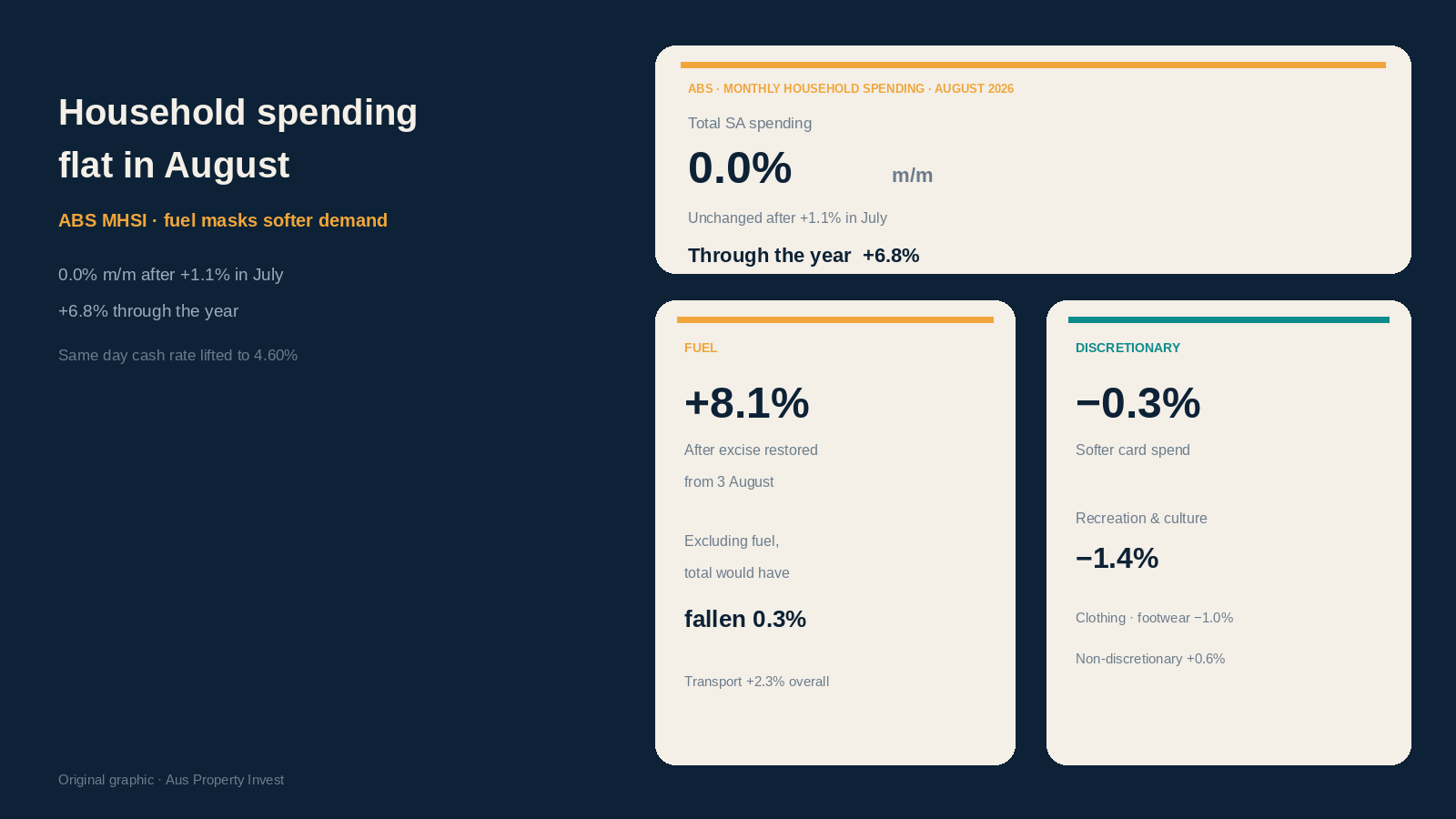
Seasonally adjusted current-price figures from the Australian Bureau of Statistics Monthly Household Spending Indicator show total spending flat at 0.0 per cent month-on-month in August, after rises of 1.1 per cent in July and 0.9 per cent in June. Through the year, spending was 6.8 per cent higher than August 2025. The ABS media release put the pause plainly: recreation and culture fell 1.4 per cent after months of event-related lift, with clothing and footwear, recreational goods, food, health and furniture also down, while transport rose 2.3 per cent.
That transport print is the story under the headline. Fuel spending rose 8.1 per cent in August after the full restoration of fuel excise duty from 3 August, ending the Federal Government Fuel Tax Relief measures that began on 1 April. The ABS says that excluding fuel, total household spending would have fallen 0.3 per cent. Experimental volume estimates show fuel volumes down 0.5 per cent in August after a 4.6 per cent fall in July, with both fuel and new vehicle sales (especially electric vehicles) contributing to the higher transport spend as households respond to rising fuel prices.
Softer discretionary demand into a tighter rates setting
The composition matters more than the zero. Goods spending rose 0.3 per cent month-on-month; services fell 0.3 per cent. Discretionary spending fell 0.3 per cent, while non-discretionary rose 0.6 per cent. Across the nine published COICOP categories, only transport, hotels, cafes and restaurants (+0.8 per cent) and miscellaneous goods and services (+0.3 per cent) rose. The largest falls were recreation and culture (-1.4 per cent), clothing and footwear (-1.0 per cent) and alcoholic beverages and tobacco (-1.0 per cent).
State and territory moves were mixed. New South Wales and Queensland each rose 0.3 per cent, South Australia and the Northern Territory edged up 0.1 per cent, while Victoria fell 0.4 per cent, Western Australia 0.2 per cent, and Tasmania and the ACT 0.5 per cent. The ABS notes the indicator excludes housing, water, electricity, gas and other fuels, communication, and education services, so it is not a direct rent or mortgage-servicing print.
The same-day RBA decision raised the cash rate target by 25 basis points to 4.60 per cent, effective 30 September (cash rate overview; our write-up). The Board said consumer spending is easing gradually as expected, while housing prices have fallen in most capital cities and new housing loans have declined noticeably. A flat August spending print after strong June and July gains, with discretionary demand softer once fuel is stripped out, sits alongside that gradual-easing language rather than contradicting it. It is not a Board decision and does not change the cash-rate path; August CPI has since printed at 4.0 per cent annual (our CPI note).
For households and the property market, another 25 basis point rise tightens variable-rate repayments further into a spring market the Board itself describes as softer on prices and new lending. Softer discretionary card spend is one demand-side reading into that setting; it is not a housing-price or lending print. For the wider rates-and-housing map, see Rates vs roofs.
None of this is buy, sell, hold or refinance advice.
How this was reported
Written by Wire for Aus Property Invest. Spending figures and category detail follow the linked ABS August 2026 Monthly Household Spending Indicator and media release. RBA references are labelled and linked to the primary decision and cash-rate pages. How we report: Wire.
General information only. Not financial, investment, legal or tax advice. See our Disclaimer.