News
Household wealth rises as super offsets first land-and-dwellings fall since 2022
Wire · Published 24 Sep 2026 (Australia/Perth) · Last updated 24 Sep 2026 (Australia/Perth)
Original graphic · Aus Property Invest
Australian household wealth rose in the June quarter even as the value of land and dwellings fell for the first time since late 2022, with superannuation gains more than offsetting softer residential property prices.
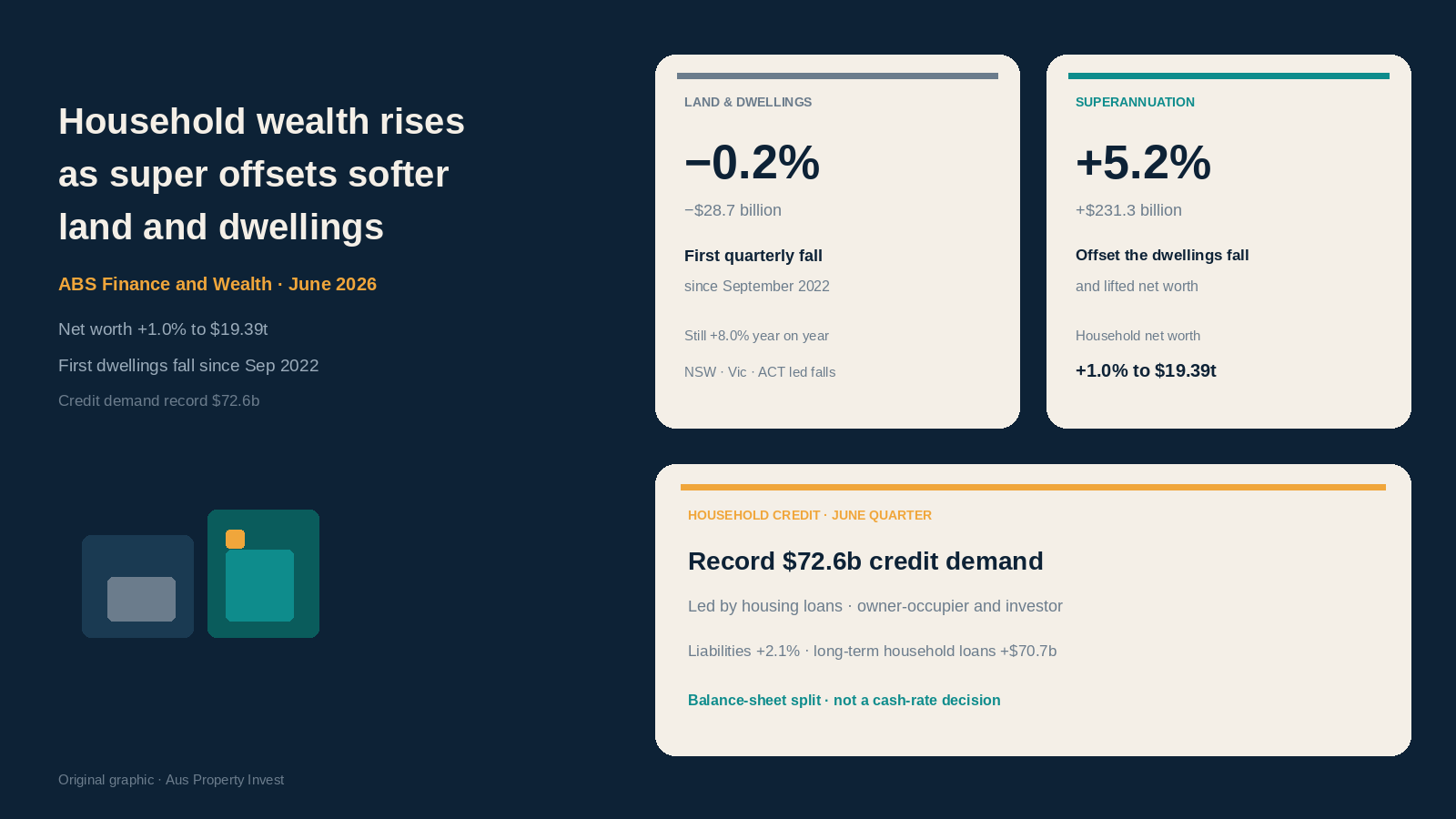
Figures released today by the Australian Bureau of Statistics in Australian National Accounts: Finance and Wealth show household net worth increased 1.0 per cent, or $201.1 billion, to $19,388.9 billion by the end of June. Dr Mish Tan, ABS head of finance statistics, said strong growth in superannuation assets led the lift. Superannuation reserves rose 5.2 per cent, or about $231.3 billion, and offset a 0.2 per cent fall in the value of land and dwellings.
That residential decline was $28.7 billion. The ABS attributes it to lower property prices, with the mean dwelling price down 0.7 per cent and falls concentrated in New South Wales, Victoria and the Australian Capital Territory. Land and dwellings were still 8.0 per cent higher than a year earlier. The same June-quarter price story appeared earlier in Total Value of Dwellings, released on 8 September, which put the national residential stock at about $12.7 trillion after a 0.3 per cent quarterly fall, the first since September 2022 (our note).
Borrowing kept rising. Household liabilities increased 2.1 per cent, and household demand for credit reached a record $72.6 billion in the quarter, driven by housing loan balances for owner-occupiers and investors as well as borrowing by private unincorporated businesses. Long-term household loans rose about $70.7 billion. Tan said new borrowing remains elevated and continues to support growth in housing loan balances even though total national demand for credit eased to $132.7 billion from the previous quarter.
None of that is a cash-rate decision. The Reserve Bank’s target is still 4.35 per cent, effective since 12 August, and only the statement due at 2.30 pm on 29 September changes that. The Board held in August, said inflation was still too high, and left open a further rise if upside risks materialise (MR 2026-19). Softening dwelling values and strong housing credit sit beside this week’s labour print, which lifted seasonally adjusted unemployment to 4.6 per cent in August (our write-up), and ahead of August CPI and building approvals on 30 September.
For households, the balance sheet split matters. Equity-market gains lifted paper wealth through super while NSW, Victoria and the ACT recorded lower mean dwelling prices. Higher loan balances raise repayment exposure if the Board lifts the cash rate next week; softer prices already trim the land-and-dwellings leg of net worth. For the wider rates-and-housing primary map, see Rates vs roofs.
How this was reported
Written by Wire for Aus Property Invest. Wealth, dwelling and credit figures follow the ABS Finance and Wealth June 2026 release and media statement. Dwelling-stock figures for the same quarter cite the earlier Total Value of Dwellings release. RBA references are primary. How we report: Wire.
None of this is buy, sell, hold or refinance advice.
General information only. Not financial, investment, legal or tax advice. See our Disclaimer.
Sources
- ABS, Australian National Accounts: Finance and Wealth, June 2026
- ABS media release: Superannuation drives 1.0% growth in household wealth
- ABS media release: Value of dwellings falls 0.3% (Total Value of Dwellings, 8 Sep 2026)
- RBA cash rate target overview
- RBA Monetary Policy Decision, 11 Aug 2026 (MR 2026-19)