News
Unemployment rises to 4.6% in August as labour market keeps easing into RBA week
Wire · Published 24 Sep 2026 (Australia/Perth) · Last updated 24 Sep 2026 (Australia/Perth)
Original graphic · Aus Property Invest
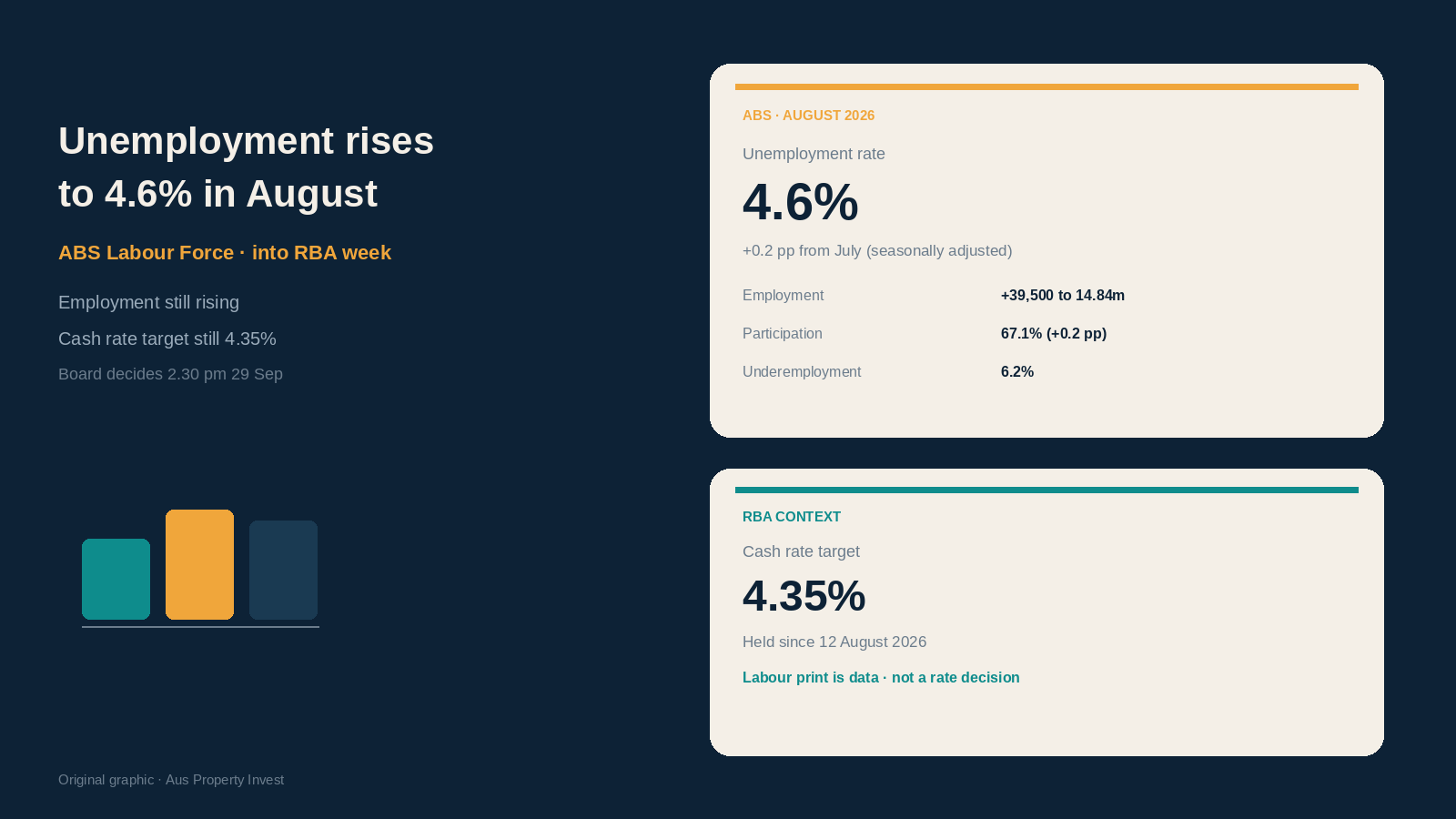
Australia’s unemployment rate rose to 4.6 per cent in August, extending the gradual easing in the labour market into the week before the Reserve Bank’s next cash-rate decision.
Seasonally adjusted figures from the Australian Bureau of Statistics show the jobless rate up 0.2 percentage points from 4.5 per cent in July. Employment still increased, by about 39,500 people to 14.84 million, as part-time work rose and full-time employment edged lower. The participation rate lifted 0.2 percentage points to 67.1 per cent, and the employment-to-population ratio rose 0.1 percentage points to 63.9 per cent. Underemployment eased slightly to 6.2 per cent. Monthly hours worked rose about 14 million to 2.01 billion.
None of that is a monetary policy decision. The cash rate target is still 4.35 per cent, effective since 12 August, and only the statement due at 2.30 pm on 29 September changes that.
The ABS notes that August completes its Labour Force Modernisation transition and that a change in Supplementary Survey collection may have a small effect on seasonally adjusted monthly movements. It continues to recommend trend estimates as the better guide to the underlying labour market. In trend terms, unemployment also sits at 4.6 per cent and employment rose about 24,000.
That print lands five days before the Board meets. It fits the softer labour path Monetary Policy Board member Iain Ross described on 22 September, when he said the labour market had eased over the past year and that there was no evidence of a wage-price spiral (our write-up). It does not, by itself, settle the inflation debate the banks and markets have been pricing. In its 11 August decision the Board held at 4.35 per cent, said inflation was still too high, and left open a further rise if upside risks materialise (MR 2026-19). Governor Michele Bullock’s recent parliamentary and CEDA comments kept the focus on supply shocks and second-round inflation effects while housing conditions have softened (House Economics). Major bank economics desks already have a September hike in their base cases (our Big Four note).
For households and the property market, a higher unemployment rate and a cooler labour backdrop usually weigh on income confidence and borrowing capacity, even while employment is still rising in levels terms. Another cash-rate rise would lift variable-rate repayments further into spring; a hold would leave the August path intact until CPI and the November meeting. August CPI and building approvals are due on 30 September, the day after the Board decision, so that inflation print will not be in the Board’s hands when it decides. For the wider rates-and-housing primary map, see Rates vs roofs.
Western Australia’s seasonally adjusted unemployment rate was 4.5 per cent in August, up 0.1 percentage points on the month, with participation at 68.4 per cent.
How this was reported
Written by Wire for Aus Property Invest. All labour figures follow the ABS August 2026 Labour Force release. RBA and bank references are labelled and linked to primary pages or our earlier notes. How we report: Wire.
None of this is buy, sell, hold or refinance advice.
General information only. Not financial, investment, legal or tax advice. See our Disclaimer.