News
RBA's Hauser says inflation outlook 'materially worse' ahead of 3 November decision
Wire · Published 23 Oct 2026 (Australia/Perth) · Last updated 23 Oct 2026 (Australia/Perth)
Original graphic · Aus Property Invest
The Reserve Bank's second most senior official has told investors the inflation outlook looks "materially worse" than the bank projected in August, putting a further rate rise firmly in play less than two weeks before the Monetary Policy Board meets on 3 November.
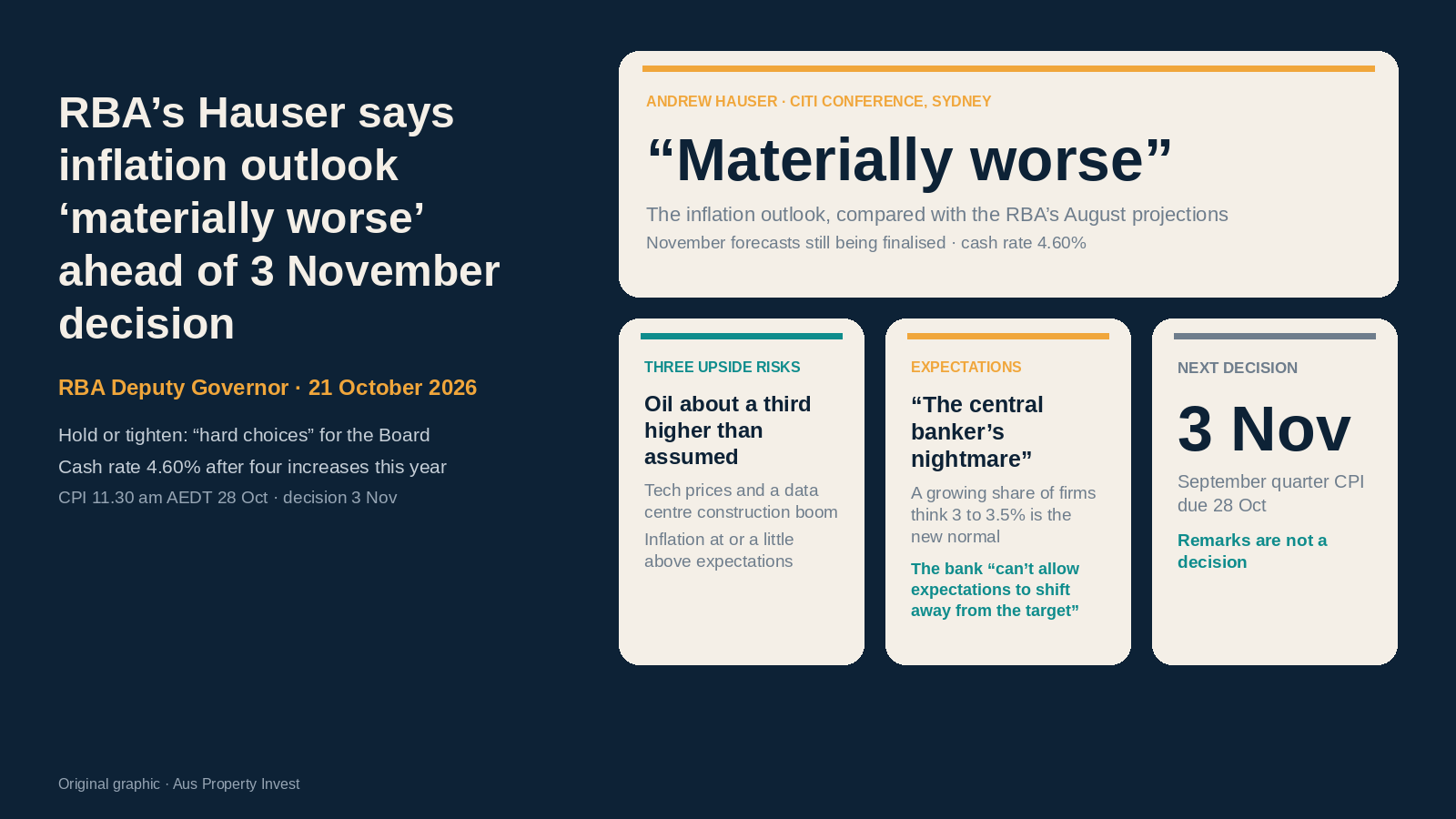
Speaking at Citi's Australia and New Zealand Investment Conference in Sydney on 21 October, Deputy Governor Andrew Hauser said staff were still finalising the November forecasts, "so I don't know for sure, but a few things are clear". He pointed to the same three upside risks the Board flagged in August. Oil prices are about a third higher than assumed in the August projections, rising technology prices and a data centre construction boom are adding to demand, and inflation has been coming in at or a little above expectations despite an easing labour market, with the fastest price rises in components most tied to domestic capacity, such as market services (August CPI).
Hauser also flagged inflation expectations. He said the RBA was hearing through its business liaison, and seeing in the business survey it runs with Macquarie University, that a growing share of firms think "three to three and a half per cent is the new normal". He called that "the central banker's nightmare" and said the bank "can't allow expectations to shift away from the target". Staff are also reviewing whether the bank's judgment on labour market capacity needs to change again, a point first raised in the September minutes.
The cash rate target is 4.60 per cent, after four increases this year, the latest on 29 September (September hike). Hauser's remarks are not a decision. Only the Board statement on 3 November changes the rate.
A hard choice, in the Deputy Governor's words
Hauser did not say which way the Board would go. He set the meeting up as a trade-off between doing more on inflation, "recognising that that means weaker activity, weaker labour market", or holding "our horses to protect the labour market" while accepting the risk that upside inflation becomes embedded and "more expensive to deal with". He said those were "hard choices" the Board was "facing into as we meet the week after next".
On activity he was more mixed. He said the economy needs a period of below-trend growth and is getting one, described the housing market as "undergoing quite a major correction", and said household confidence is very weak, while overseas demand and onshore data centre investment remain strong. "Monetary policy is working," he said, but "the inflation outlook has deteriorated."
Two days earlier, Assistant Governor (Financial Markets) Christopher Kent told the Commonwealth Bank's Global Markets Conference that the RBA judges financial conditions "somewhat restrictive", with the cash rate path sitting at the upper end of the bank's range of neutral-rate estimates, but that the question the Board faces at each meeting is whether policy is "restrictive enough". Kent said housing credit growth has been weakening, with "an extra kick down" from tax changes affecting investors, and that house prices, turnover and dwelling investment indicators were softening.
Hauser's moderator noted markets had been pricing only about eight basis points of tightening for November before he spoke. CBA's rates research team says his comments lifted market-implied odds of a November increase from about 24 per cent to 56 per cent. That is market pricing as reported by a bank, not an RBA view.
Bank economists remain split. Westpac's October Market Outlook says the RBA "looks set to follow up in November, taking the cash rate to a new cycle high". Commonwealth Bank still expects a hold, but its economists said on 22 October the meeting is "live" and will depend heavily on the September quarter CPI. These are bank economics forecasts, not RBA guidance.
The next hard data point is the ABS Consumer Price Index for September and the September quarter, due at 11.30 am AEDT on Wednesday 28 October. CBA expects quarterly trimmed mean inflation of 1.0 per cent, above the RBA's August forecast of 0.8 per cent, and annual trimmed mean of 3.6 per cent. The same morning, from 11.15 am AEDT, Governor Michele Bullock, Hauser and Assistant Governors Sarah Hunter, Brad Jones and Christopher Kent are listed to appear by videoconference before the Senate Economics Legislation Committee at Supplementary Budget Estimates.
None of this is buy, sell, hold or refinance advice.
How this was reported
Written by Wire for Aus Property Invest. Quotes from Hauser and Kent are taken from the RBA's published transcripts of each fireside chat. The cash rate and meeting calendar are from the RBA website and the CPI release time from the ABS release calendar. Market pricing figures and bank forecasts are attributed to the banks that published them and have not been independently verified against market data. How we report: Wire.
General information only. Not financial, investment, legal or tax advice. See our Disclaimer.
Sources
- RBA, Fireside Chat by Andrew Hauser, Deputy Governor, Citi Australia & New Zealand Investment Conference, 21 October 2026
- RBA, Fireside Chat with Christopher Kent, Assistant Governor (Financial Markets), CBA Global Markets Conference, 19 October 2026
- RBA Monetary Policy Decision, 29 September 2026 (MR 2026-27)
- RBA Minutes, 29 September 2026 meeting
- RBA cash rate target
- RBA Coming Up
- ABS release calendar, future releases
- CommBank Newsroom (bank view), September data will keep inflation pressure on RBA, 22 October 2026
- CommBank Newsroom (bank view), CommBank economists stick with November RBA interest rates call, 19 October 2026
- Westpac IQ (bank view), Westpac Market Outlook, October 2026